Leak Fixing Help
- Shut off your stopcock first. It’s usually under the kitchen sink — turn it clockwise to stop water flow instantly.
- Stay away from electrics. If water is near sockets or fittings, switch off the mains at the fuse box immediately.
- Contain the damage. Buckets, towels, and moving furniture takes minutes but can save hundreds in repair costs.
- Take photos before you mop up. Your handyman will diagnose the problem faster with visual evidence.
- Most leaks don’t need a plumber. Taps, pipes, radiator valves, and seals are all within a handyman’s scope.
- The sooner you call, the less it costs. Water damage compounds quickly — same-day help is available across London.
"*" indicates required fields
A dripping pipe under the sink. A damp patch spreading across the ceiling. A puddle forming where there was none yesterday. Leaks have a way of appearing at the worst possible moment — and the panic that follows can make things worse. If you’re searching for a leak fixing handyman in London, you’ve probably already got water where it shouldn’t be.
This guide will walk you through exactly what to do right now, before help arrives. Acting quickly and calmly in the first few minutes can be the difference between a minor repair and a costly renovation.
Don’t Panic – Here’s What to Do Right Now
The most important thing you can do when you spot a leak is stay calm and act methodically. Water damage escalates quickly, but most leaks are manageable if you respond sensibly in the first few minutes.
Start by identifying the source. Is it coming from a pipe, a fitting, a radiator, or somewhere you can’t immediately see? Look for wet patches on walls or ceilings above the problem area — water often travels before it drips. Take a photo if you can; it’ll help your handyman diagnose the issue faster when they arrive.
Next, move anything valuable, electrical, or water-sensitive away from the affected area. Switch off any nearby electrical sockets or appliances if water is near them — safety comes first.
If the leak is severe, don’t wait. Shut off your water supply immediately, then call for urgent leak repair straight away.
How to Shut Off Your Water Supply
Knowing how to stop the water is one of the most useful things you can do in a leak emergency.
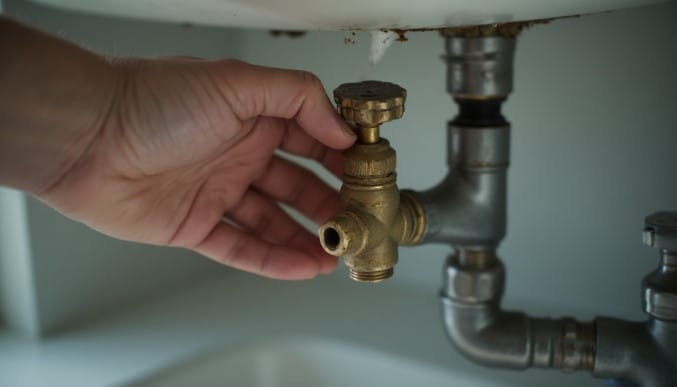
Your stopcock is the main valve that controls water coming into your property. In most London homes, it’s located under the kitchen sink, in a utility cupboard, or near the front door. Turn it clockwise to close it — “righty tighty, lefty loosey” is the rule.
If you can’t find your internal stopcock, or it’s seized and won’t turn, there may be an external stopcock in a small cover in the pavement outside your property. You’ll need a special key (sometimes called a stopcock key) to access it — these are available from DIY shops.
Once the water is off, run a cold tap to relieve any pressure remaining in the pipes. This will slow or stop most leaks almost immediately.
If the leak is isolated to a single appliance — a washing machine or dishwasher, for example — there may be an isolation valve on the supply pipe directly behind it. A flat-head screwdriver turned a quarter-turn can close this without affecting the rest of your water supply.
Minimising Damage While You Wait
With the water off or slowed, your next task is containment. Every minute counts when it comes to water damage.
Place towels, buckets, or bowls under any drips. If water is coming through a ceiling, gently press on the wet area to find where it’s pooled — sometimes releasing that pressure by making a small hole prevents a larger ceiling collapse. (If the bulge is large, contact your handyman before doing this.)
Lift rugs, move furniture, and protect flooring. If water has reached a wooden floor, dry it as quickly as possible to prevent warping. Use a mop, old towels, or even a wet-dry vacuum if you have one.
Open windows if it’s safe to do so — improving ventilation helps the area dry out faster and reduces the risk of mould developing later.
If water is near any electrics — light fittings, sockets, consumer units — do not touch them. Turn off the mains electricity at the fuse box and call your handyman or an electrician immediately.
What Types of Leaks Can a Handyman Fix?
A skilled leak fixing handyman can handle a wide range of common household leaks, including:
- Leaking taps and mixer taps — worn washers, O-rings, or cartridges
- Dripping pipes — including burst or cracked pipe sections and loose joints
- Leaking radiator valves — common in older central heating systems
- Under-sink leaks — from supply pipes, waste pipes, or P-traps
- Leaking shower trays or bath seals — often caused by failed silicone sealant
- Overflowing toilet cisterns — faulty ballcock valves or fill valves
- Leaking washing machine connections — supply hoses or drain hose fittings
For most of these jobs, a reliable handyman carries the tools and parts needed to complete the repair in a single visit.
When Do You Need a Plumber Instead?
There’s some overlap between what a handyman and a qualified plumber can do, but certain situations genuinely require a Gas Safe registered plumber or specialist.
You’ll need a plumber if:
- The leak involves your boiler, gas supply, or central heating pipework.
- You suspect a problem with your mains water supply outside the property
- The work requires notifiable plumbing under building regulations (such as replacing a soil stack)
- There’s a significant burst affecting multiple areas of your home
- You need a new bathroom or full pipe installation
If you’re ever in doubt, a good handyman will tell you honestly whether the job is within their scope. For a straightforward emergency plumber handyman situation — a dripping pipe, a leaking tap, a failed seal — a handyman is often the faster, more affordable option.
What to Tell the Handyman When They Arrive
The more clearly you can describe the problem, the faster the repair. When your handyman arrives, be ready to explain:
- Where the leak is — which room, which fixture, which wall or ceiling
- When you first noticed it — and whether it’s getting better or worse
- What you’ve already done — particularly if you’ve shut off the water
- Whether there’s been any previous work in that area — this can help identify the cause
- Any photos you took — these are genuinely useful
Point out the location of your stopcock if they need to isolate the supply. If you’ve managed the leak well before they arrive, let them know — it means they can assess the damage properly and plan the repair accordingly.
Common Questions About Leak Repairs in London
What Our Customer Say’s
These are some of the responses from our customers who are very satisfied

Great service, punctual and as expected.
Great efficient service, came on time, really conscious of keeping our flat clean and tidy by taping plastic bag to catch the dust from the drilling, didn’t even need to tell him to take his shoes off (we have no shoes policy). Really impressed with the service, definitely use Bob’s Handyman Service again.
Very good service! They came on time, very happy I used your services!
Good job done. Dishwater installed perfectly. Arrived on time, easy booking and reliable staff.
It was quick, professional executed in every way and done by a very friendly and peasant guy. Thank you. I will definitely use you again and recommend you to others.
Bob’s Handyman team did a great job the first time I called them. I would certainly be happy to use their services again.
Great job! I highly recommend them!
Great value for money. Reliable workmen, competitive prices and very efficient. Will use your company again.
I was very impressed with your service – it was the first time I used it, but it surely will not the last!
Thank you Bob’s Handyman for the amazing job done on my bathroom. Very professional company.
I would definitely book them again, if I need help!
It was a pleasure to deal with your staff.
Excellent service! I needed a whole room repainted and the people you sent did a wonderful job. I would recommend you to my friends.
I’ve been using these guys for over an year now and they are brilliant every single time. No matter of its something small or a job that needs a lot of skills they do it professionally. I’ve been recommending them to everyone.
I was really pleased with the work that was completed on time. The handyman who came did the jobs quickly and efficiently and left everything tidy.
I’m very pleased with the carried out work. The handyman was very knowledgeable, worked tidy and quickly and did e great job. Will be recommending your services.
The job was for my parents who were very happy with the person who did the job and would definitely use your services again.
Your handy man put in extra effort to do the job, which I appreciate very much.