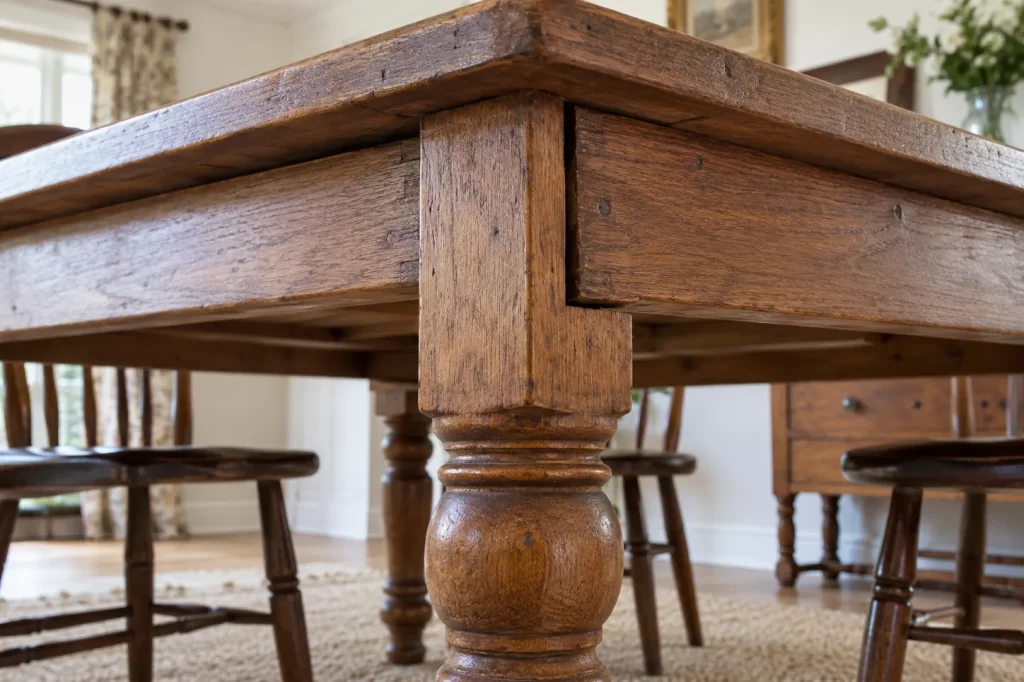
A table can rock because one foot does not meet the floor, because the floor itself slopes, or because a joint in the frame has loosened. These faults feel similar when a cup rattles, but they need different repairs. Start by clearing the table and observing exactly what moves. A pad under one leg may stop a floor-related wobble; it cannot make a failing leg-to-frame joint safe.
The most useful first test is to move a manageable table to a known flat area and see whether the wobble follows it. Do not drag a heavy dining table with its top loaded. Lift it with adequate help from appropriate points on the frame, protecting the floor. If the table is an antique, has a stone or glass top, or has a visibly detached leg, ask a furniture repairer to assess it before moving it.
Watch the feet and frame separately
Place the empty table where it normally stands and press gently on opposite corners of the top. Watch which foot lifts. If the same foot repeatedly rises from the floor while every leg remains firm at the frame, the support points may be uneven. If the leg itself shifts relative to the apron or mounting plate, there is a joint problem even if all four feet touch the floor at rest.
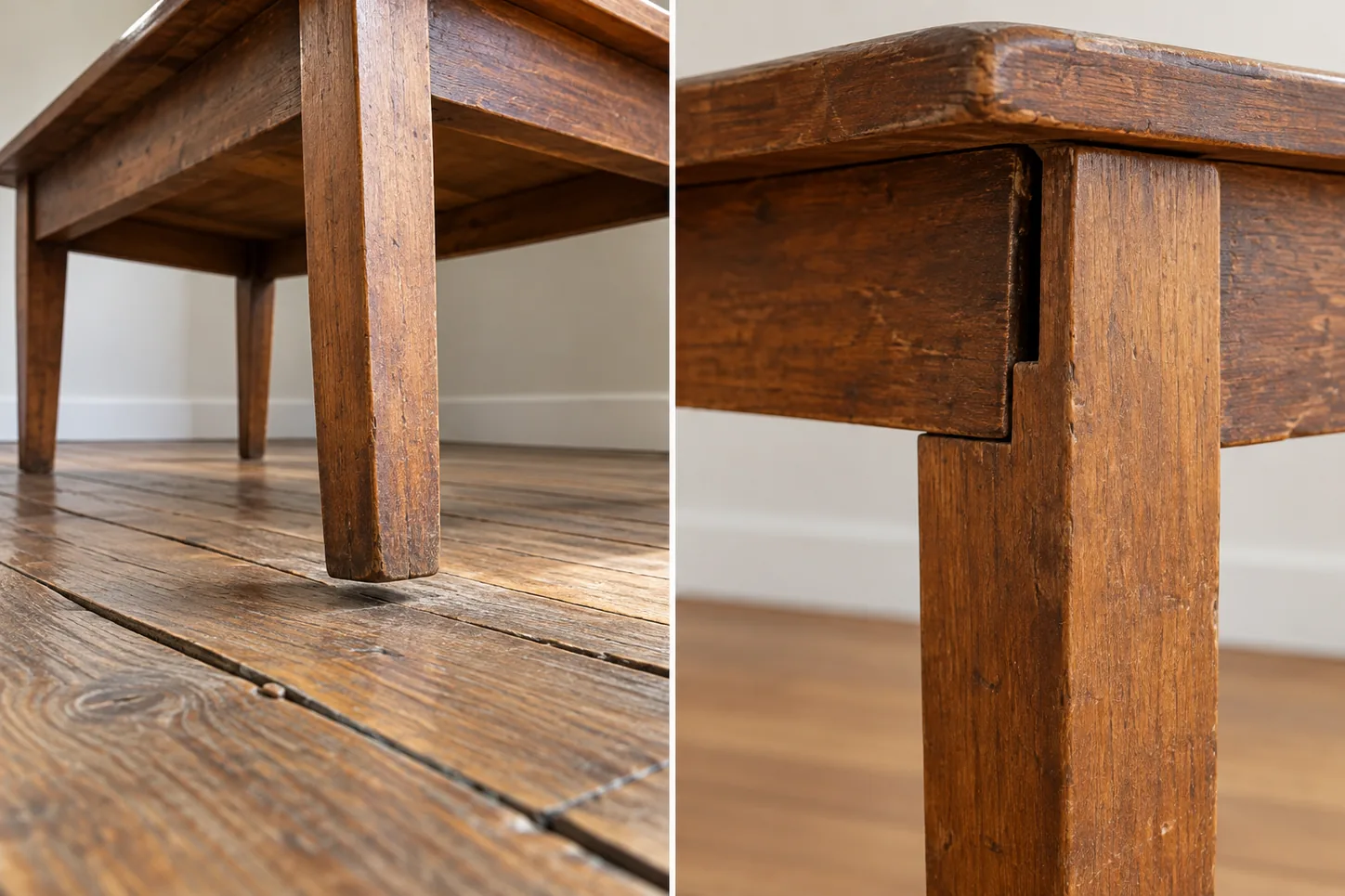
Ask another person to observe if you cannot see underneath while applying a light pressure. Keep fingers out of an opening joint. Look for a growing gap where the leg meets the apron, a loose bolt plate, a broken wooden corner block or fresh cracks in the finish. The noise can help: a dull shift from the frame differs from a foot tapping on a hard floor, but do not diagnose by sound alone.
Check each foot for a missing glide or felt pad. One foot with a worn pad can sit slightly shorter. A pad under a different leg may have been added during an earlier attempt and is now compressing. Floors can also have local dips near old boards, tiles or thresholds. A table that stands steady after being rotated or moved a short distance is giving evidence about the floor rather than proof of a sound frame; still inspect the joints before reloading it.
Test on a reliable level surface
A small spirit level on the tabletop can show slope, but a level top does not by itself mean every leg is sound. A table may be built or settled with slight variation, and an uneven floor can support it at only three points. Place the table on another stable area, ideally a broad hard floor known to support other furniture evenly. Avoid testing on a soft rug, which can disguise a gap by compressing.
If the wobble disappears in the new location, examine the original floor and the feet. A small adjustable glide may compensate for modest floor variation if the table design accepts one and the fitting can be installed without damaging the leg. A discreet felt pad can help with a tiny difference on a light table, but several stacked pads can slide or compress unpredictably. Do not wedge the table against a wall to stop movement; it can mark plaster and hide a deteriorating joint.
If the wobble follows the table, measure the feet relative to one another only after confirming the joints are firm. An old table may have a worn foot or a replacement leg cut differently. Shortening three sound legs to match one short leg is an irreversible and usually poor first response. A repairer may use a suitable adjustable foot, replace a damaged glide or make a controlled correction once the frame is secure.
Inspect how the leg is attached
Tables use many constructions. A traditional wooden table may have mortise-and-tenon joints between legs and aprons, reinforced by corner blocks. Another may use bolted plates or threaded inserts. A flat-pack table may have cam connectors or screws into engineered board. The fix depends on which parts actually carry the load.
Turn a small table on its side only if it can be supported safely without loading the edge or finish. For a heavy table, inspect from beneath with a torch while it remains upright. Look for bolts that have backed off, a plate lifting from wood, cracks beside screw holes and a joint that opens under a gentle sideways push. A bolt that tightens and stays tight may be a simple fix; one that spins or immediately loosens indicates a failed thread or substrate.
Wooden joints are more involved. If an old glue line has separated, squeezing fresh glue into the visible gap while the table stands upright seldom reaches all mating surfaces. Proper repair may require controlled disassembly, cleaning old adhesive, confirming fit and clamping square. Screwing across the outside of a joint can split a leg or spoil the appearance without restoring the original load path. The article on reinforcing a wobbly wooden chair covers a different piece of furniture but illustrates why extra screws are not a universal cure.
Do not confuse movement with top flex
Some large tables flex slightly at the top under load, especially with extension leaves. That is not the same as a whole table rocking on its feet. Check whether the movement occurs only at a removable leaf, rail or tabletop fixing. A leaf that is not fully seated can rattle without the legs moving. Use the maker’s mechanism instructions before adjusting extension hardware.
Observe the table from the side while someone places a modest weight near the centre. If the top bends while the frame stays still, the issue may be top support or load rather than a leg. Do not test with excessive weight. Stop if a crack opens, a bolt pulls or the table shifts suddenly. A heavy stone or glass top presents a particular hazard: do not lift it just to reach a frame fixing unless the correct handling method and adequate help are available.
Where the frame is engineered board, inspect screw holes carefully. Particleboard can crush around a fitting, leaving a screw that turns without holding. The site’s guide to repairing stripped screw holes in flat-pack furniture explains that material problem. A larger screw driven at random may reach nothing sound and can split a thin panel.
Choose the remedy that matches the diagnosis
For sound joints and a small floor-related mismatch, use appropriate glides or pads designed for the foot and floor. Adjust a threaded glide a little at a time, then check the table in its normal position with chairs pulled out. A projecting foot can catch someone, and an overly soft pad can compress when the table is used. Recheck after a week, particularly on a rug.
For a loose bolted connection, follow the manufacturer’s tightening instructions and inspect the threaded insert or plate. If the fitting has pulled out, the surrounding wood may need repair or a matched replacement component. For a failed traditional joint, a sound repair restores the mating surfaces and frame square; cosmetic filler belongs only after the joint is stable. Cracked or rotten timber may require a replacement section.
If several joints move, do not repair one in isolation and immediately reload the table. The frame may have racked, placing stress across the apron and corner blocks. A carpentry repair can assess a timber frame; the site’s furniture assembly service is relevant for a table whose bolted or flat-pack construction needs proper reassembly. Mention the table material, where it wobbles, and whether it remains unstable on another floor.
Keep a stable table stable
Avoid dragging a loaded table by one corner. The twisting force can loosen joints even when its vertical load is within normal use. Lift with enough help, protect the feet and set it down without rocking. Check glides and bolts periodically, especially after a move. Promptly clean spills around wooden joints so moisture does not sit in open grain.
The final test is practical: with the table empty, all feet should support it at its normal location, the frame should show no visible joint movement under gentle pressure, and the top should not shift unexpectedly. If a pad solves the floor contact but a joint still opens, the table is not repaired. Deal with the floor and the frame as separate problems, and the wobble will stay fixed for the right reason.