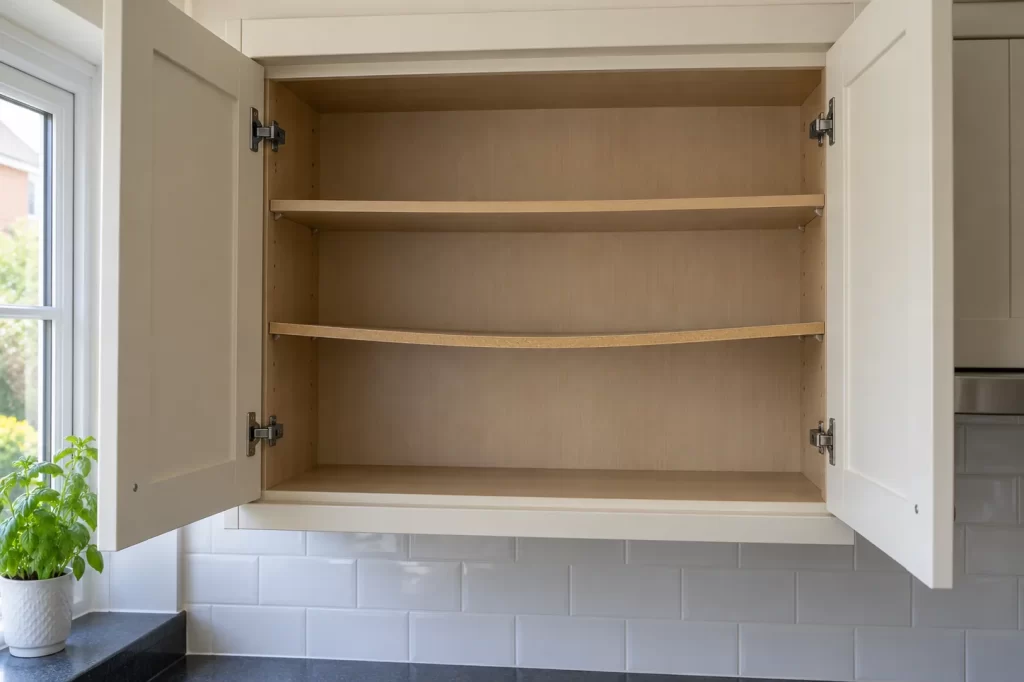
A shelf that dips in the middle is giving an early warning. It may be carrying too much weight for its span, one support pin may have moved, or the board may have weakened after getting damp. Empty it before the shelf drops and damages what is below. Then examine the supports, the board and the cabinet sides separately. Adding another pin or turning the shelf over will not solve every cause.
This guide concerns removable shelves in ordinary kitchen cabinets. A fixed shelf that forms part of the cabinet’s structure needs more care: cutting or moving it could weaken the unit. A wall cupboard that moves at its wall fixings is a different safety issue. Do not reload it until the cabinet itself has been assessed.
Empty the shelf and record how it sits
Take everything off the shelf, including light items. Stack dishes somewhere stable rather than on the floor in a traffic area. Photograph the sag while it is still installed, noting which edge dips and whether one corner has dropped. A shelf bowed smoothly across the centre points towards load and span; one corner markedly lower suggests a missing or badly seated support.
Check whether heavy plates, bottles or tins were concentrated in the middle. The cumulative weight of several modest items can be substantial, especially in a wide wall unit. Move heavy items to a lower, better-supported cabinet while the issue is assessed. A sagging shelf is not simply a cosmetic fault: a pin can pull out or the board can crack without much warning.
Remove the shelf only if it lifts freely from its supports. Some have retaining clips or a small screw to keep them from tipping. Do not wrench a trapped shelf against a cabinet hinge. Lay it on a flat, dry surface and see whether it remains bowed after unloading. A board that stays visibly curved or has cracked edges may need replacement.
Inspect all four support points
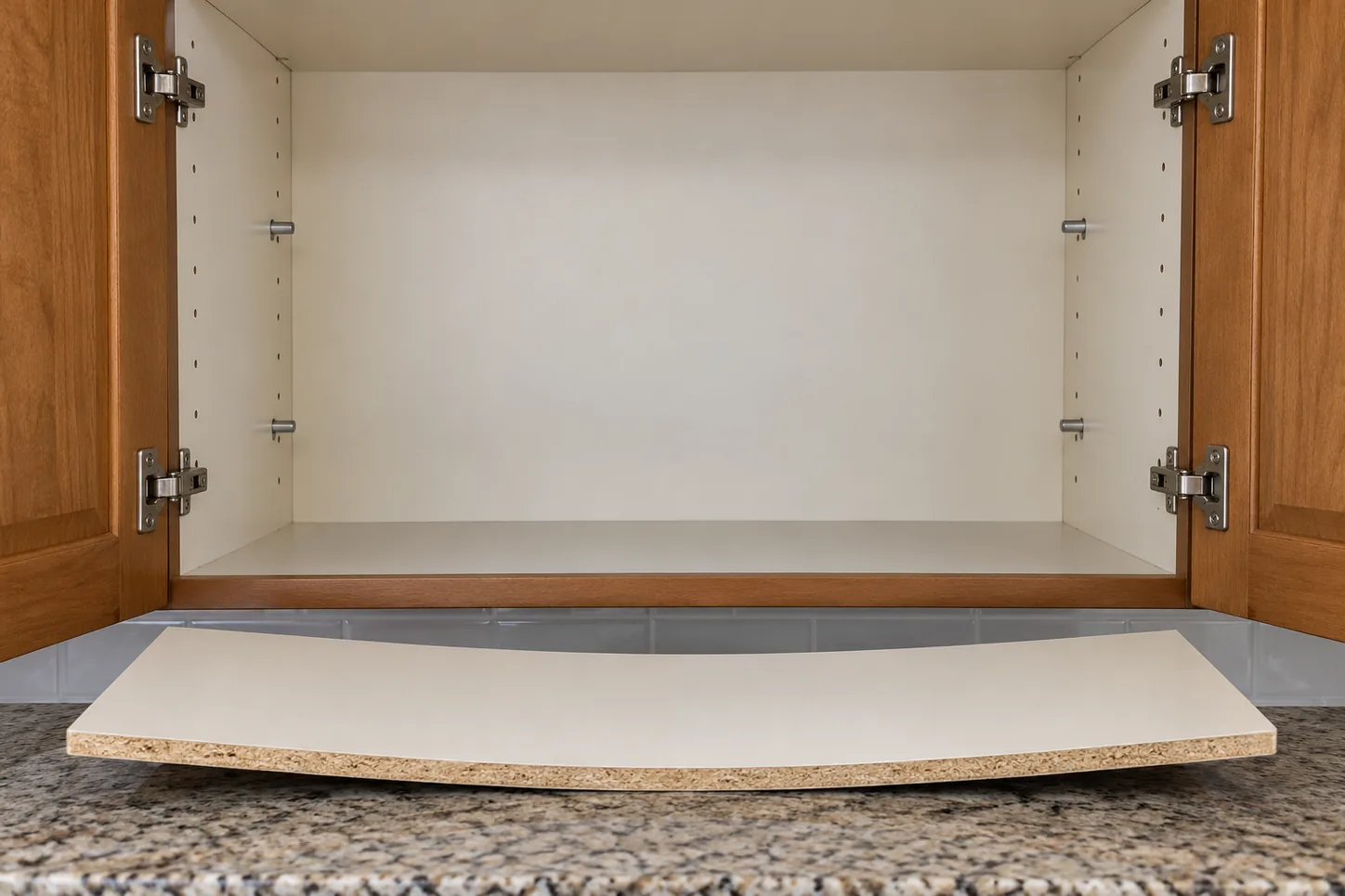
Many adjustable shelves rest on four pins inserted into rows of holes in the cabinet sides. Confirm that there are four supports of the same type and that each is fully seated at the same height. A missing pin can let one edge drop while the other three appear intact. Some pins have a flat shelf-bearing surface that must face upward; others have a retaining detail. Match the original system rather than mixing arbitrary hardware.
Look closely at the holes. If the cabinet side has crumbled or enlarged around a pin, simply pushing it back into the same hole is unlikely to hold. Damp chipboard can lose its grip even when the pin itself looks sound. A pin that tilts under a light hand pressure suggests the substrate needs repair. Do not test it by reloading with crockery.
Check for shelf notches or grooves that locate over the pins. A shelf installed backwards may not sit fully on all supports. If the cabinet has adjustable hinges or a door that is out of line, that is a separate issue covered in the guide to adjusting kitchen cupboard doors. Correct shelf seating before considering door clearance.
Look for moisture, not just excess weight
Inspect the shelf edge and cabinet sides for swelling, bubbling laminate, dark staining or a musty smell. A wall unit near a kettle may see persistent steam; a unit below a sink may be exposed to intermittent leaks. Chipboard that has swollen at an exposed edge is structurally different from a dry board that flexed under load. Drying may stop further damage, but it seldom returns the original strength or dimensions.
If water is present, find the source before fitting a new shelf. Keep electrical items clear of wet cabinetry and arrange appropriate help if a leak is active. A replacement board installed in the same damp space can fail again. Do not conceal staining with adhesive film or paint before the area has been inspected and dried.
The edge finish matters too. A chipped or unsealed front edge lets moisture reach the core during cleaning. Even a sound-looking white surface may hide a soft brown edge. Press gently near a suspect area with a blunt object; do not rely on a heavy load test. A soft or crumbling board should be replaced, not merely propped up from beneath.
Decide whether the span needs more support
Shelf material, thickness, depth and unsupported width all affect how much it can hold. A wider shelf of the same board will bend more under the same load. There is no safe universal weight limit for “a kitchen shelf” without knowing the material and cabinet design. Check any manufacturer guidance for the unit. If none exists, distribute lighter items and avoid concentrated loads.
An additional centre support can sometimes help a long shelf, but it must transfer load into a sound part of the cabinet. A small bracket screwed into thin hardboard at the back is not a reliable structural support. Equally, a centre batten may obstruct appliances, doors or stored items. A carpenter can assess whether a stronger replacement board, a suitable front-edge stiffener or a proper centre support best suits the unit.
Turning a bowed shelf upside down is a temporary temptation. It may appear flatter at first, but a damaged board can continue deforming, and the finished faces or locating notches may no longer sit correctly. If it had been heavily overloaded, replacing it with a properly sized and supported board is more dependable. Do not cut a replacement so tightly that it pushes the cabinet sides apart.
Measure a replacement correctly
Measure the clear width between cabinet sides at both front and back; older or adjusted units may not be perfectly square. Record shelf depth, board thickness, edge finish and any notches around hinges or pipes. A removable shelf needs enough clearance to be inserted and lifted out while still resting fully on its supports. Use the existing shelf as a pattern only after checking whether it was originally cut accurately.
Choose a material suited to kitchen use and the intended load. A decorative melamine surface does not, by itself, tell you the strength of the core. Exposed cut edges should be finished appropriately so routine humidity does not reach the board. If the shelf is to carry heavy crockery or small appliances, ask for a load-aware design rather than simply copying a failed thin panel.
Check the support pins against the new board’s thickness and edge profile. A shelf with a shaped front may need to be oriented one way. Seat it evenly on all four points, then apply a light load first and confirm it does not rock or tip. Gradually return items, spreading weight across the shelf and keeping heavier objects closer to the supporting sides where practical.
When the cabinet needs more than a shelf
If support holes are badly worn, side panels are swollen, the cabinet has pulled from the wall or several shelves have bowed, the problem may be the unit rather than one panel. The existing guide to stripped screw holes in flat-pack furniture explains a related material failure, although shelf-pin holes need their own repair decision. A carpentry assessment can identify whether the sides remain sound enough to carry a new shelf. For a straightforward minor fitting job, the site’s handyman and odd-jobs service is relevant.
Describe the cabinet width, the shelf material if known, whether the board remains bowed when unloaded and whether any pin holes are damaged. Photos of the empty cabinet and removed shelf help. A stable repair restores both the load path and the board, then changes how the shelf is used so the same dip does not return.