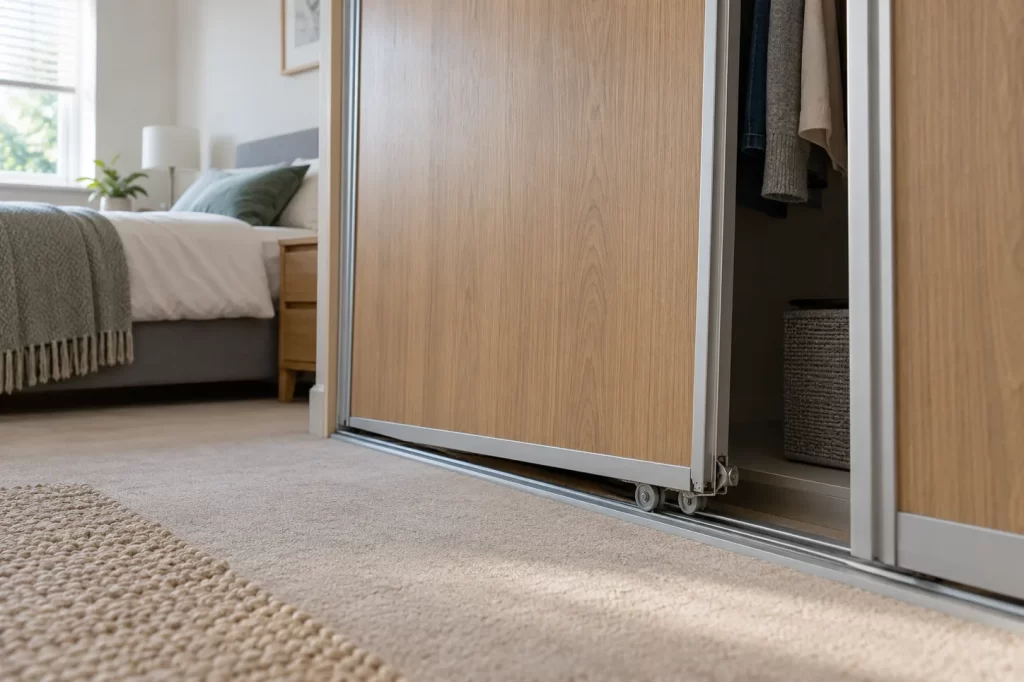
When a sliding wardrobe door jumps its track, stop moving it until you know how the system supports its weight. Some doors hang from an upper rail, others roll on a lower track, and many use both a load-bearing part and a guide. Lifting the panel at the wrong point can release it suddenly. A door that is heavy, mirrored, glazed or taller than you can control comfortably should be handled by two competent people or a fitter.
For a lighter, accessible panel, the first useful checks are simple: look for debris in the track, a roller that has dropped or broken, a guide that has come loose, and a door that is no longer square to the opening. Those observations help you decide whether cleaning, adjustment or a replacement component is required. Forcing the panel back into place without finding the cause usually makes the next derailment more likely.
Identify the track system before lifting anything
Open the wardrobe as far as it will move smoothly and inspect both the top and bottom edges with a torch. A bottom-rolling system often has visible wheels carrying the panel in a floor track, with a guide above. A top-hung system carries weight at the head and uses a lower guide mainly to stop the panel swinging. Hardware can be concealed behind trim, so do not assume what you see first is the load-bearing part.
Look for a maker’s label or installation instructions inside the wardrobe. Many systems have a particular sequence for releasing and refitting panels. Some rollers are spring-loaded; others use a captive bracket or adjustment screw. The correct method may vary between an ordinary timber-look panel and a heavy mirrored panel. If you cannot identify the system, pause rather than improvising with a screwdriver under the glass or frame.
Check whether the door has actually left the rail. A panel may feel derailed because it drags against a carpet edge, scrapes a side jamb or catches on a screw head. A runner can also make a grinding noise while still seated. Watch the bottom edge from a safe position as the door is moved only a few centimetres; this can distinguish a wheel climbing out of the channel from a panel rubbing beside it.
Inspect the track without dismantling the wardrobe
Dust, grit, small toys and broken plastic fragments can accumulate in a lower channel. A roller encountering a hard object may lift and drop into the wrong groove. Vacuum loose debris with a narrow nozzle, then wipe the track with a dry or lightly damp cloth according to the system’s instructions. Do not flood a chipboard wardrobe base or leave moisture beneath a floor rail.
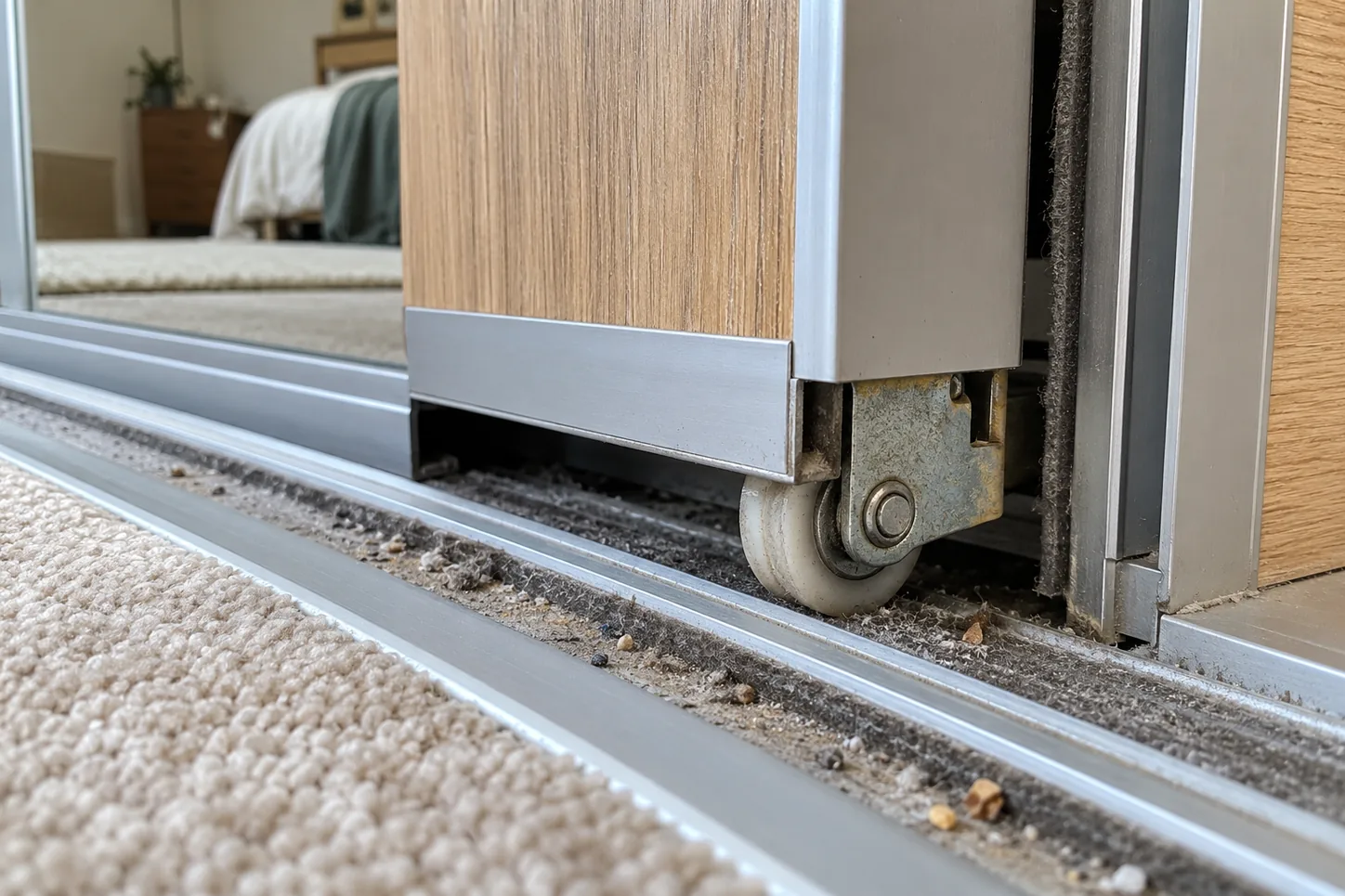
Look along the rail for dents, loose screws, lifted ends and an uneven joint between track sections. If a screw has backed out, it may catch the wheel repeatedly. Tightening it into sound material may be enough, but a screw that spins in the hole indicates a failed fixing. Do not replace it with an arbitrary long screw; flooring, services or a weak panel core may be beneath the track. A bent metal track or cracked plastic guide may need a matching part rather than more force.
Do not apply thick grease to an open lower track unless the manufacturer specifies it. It can hold grit and make cleaning harder. Some rollers are designed to run dry; some mechanisms have particular lubrication points. The wrong product can damage plastics or collect dust.
Check rollers, guides and door alignment
If you can see the rollers without removing the panel, compare both ends. One wheel may sit lower, wobble or fail to turn freely. A cracked wheel rim can climb the rail. A mounting bracket that has loosened lets the panel tilt, so the opposite end may appear to be the problem even when the damaged part is elsewhere.
Examine the upper guide as well. A missing guide block can allow a bottom-rolling door to lean out; a loose top hanger can let a top-hung panel drop. The adjustment screw, if present, is not a general-purpose cure. Before turning it, note its starting position and check the manufacturer’s directions. Small adjustments can make the door more level, but excessive adjustment may reduce roller engagement or cause the panel to strike the frame.
Stand back and compare the vertical gap between the door and the wardrobe side from top to bottom. If the gap tapers, the panel may be tilted or the wardrobe carcass may be out of square. A new carpet, uneven floor or a wardrobe that has shifted after being moved can affect the track. A fitter may need to correct the base or frame before adjusting the doors. Otherwise the roller will keep climbing the same edge.
The published guide to a drawer that sticks or comes off its runners covers a different mechanism, but shares a useful diagnostic principle: clear the track and check both sides before replacing a component. Sliding wardrobes carry much greater panel weight, so apply a stricter limit to what you attempt alone.
Refit only when the panel is controllable
If the system instructions confirm a safe refitting sequence and the panel is small enough for two people to control, clear the area and remove nearby obstacles. Protect the floor and do not hold a panel solely by a decorative trim or mirror edge. Each person should support the solid frame at a stable point. Follow the maker’s sequence for engaging the load-bearing rail first and then the guide. Do not lever a roller past a retaining lip; that can break its bracket.
Once seated, move the panel through its full travel slowly while someone watches the rollers and guides. It should not jump, grind or scrape. Test both directions, because an issue at one end of the track may only appear when the door is fully open. Check the overlap with the neighbouring panel so handles and trims do not collide.
If the panel will not stay engaged after one careful attempt, stop. Repeated lifting can loosen the hardware and increases the chance of a drop. A mirrored door has additional risk: a crack may not be obvious from the front, and a heavy glazed panel can be difficult to arrest once it tips. A damaged mirror or loose glass requires professional handling.
Repair or replace the failed part?
A clean, intact track and a sound roller that was displaced by a one-off obstruction may need only proper refitting and monitoring. A wheel with a flat spot, seized bearing or broken axle needs a compatible replacement. A bent rail may need replacement as a complete length so the wheel has a consistent path. A cracked guide or missing stopper should be matched to the original system where possible.
Photograph the hardware and any markings before ordering parts. Measure the wheel diameter, bracket shape, track profile and fixing positions only when the parts can be accessed safely. Similar-looking rollers do not necessarily carry the same load or fit the same rail. An unsuitable substitute can run for a few days, then derail again. Keep old parts until the replacement is installed and tested.
If the wardrobe carcass has swollen at the base from water or bowed under load, a new roller will not restore alignment. The underlying furniture may need a broader carpentry repair or replacement. Where the mechanism was assembled incorrectly, the site’s furniture assembly service is relevant. The older article on furniture assembly problems gives wider context for deciding when a fitting job needs help.
Keep the door running smoothly
Once repaired, keep the lower channel free of grit, especially where carpet fibres or pet hair gather at the opening. Do not use the sliding panel as a handle for moving the entire wardrobe. Close it with a steady motion and avoid pushing at its top or bottom corner alone, which can twist the panel. Check that end stops remain secure and that stored items do not press against the back of the sliding doors.
If a door gradually becomes harder to move, investigate early. A small increase in resistance may be the first sign of a failing roller, loose track screw or shifting cabinet. Fixing that cause is usually simpler than recovering a heavy panel after it leaves the rail. The order of work is straightforward: identify the system, clear and inspect the track, check the support hardware, then refit or replace only what the evidence points to.