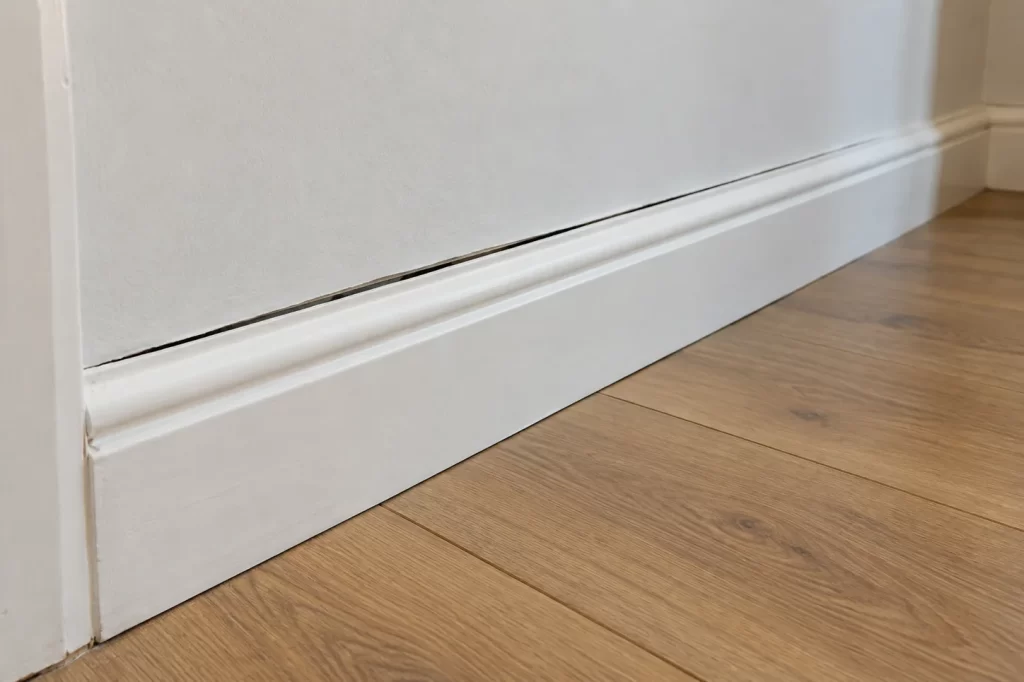
A gap above a skirting board can be a straightforward fixing problem, but first make sure the wall and timber are dry and sound. A board may pull away because old nails have lost their grip, the plaster behind them has crumbled or the wood has changed shape with the seasons. If there are water stains, swelling or a musty smell, deal with the moisture before refixing anything. This guide is for a sound board on a dry wall, not for timber damaged by a leak.
Do not try to make a loose board look fixed by filling the gap with a thick line of caulk. Caulk is a finish for a stable joint. It will crack if the skirting continues to move, and it can hide the cause. A proper repair restores contact with a suitable fixing, then finishes the small residual gap.
Check how much of the board is loose
Move furniture away and inspect the length in good light. A short section that springs away at one end may have lost a single fixing. A whole run bowing out may be under tension or fixed to a poor substrate. Look at corners and joins: if a mitre has opened, the movement may involve more than one board. Photograph the position before removing anything, particularly if the original paint line will be useful for refitting.
Press the board gently towards the wall. Does it sit flat without great force? Does the plaster behind it move? Does the top edge meet the wall evenly while the lower edge stays against the floor? Do not force it against a wall that has a pronounced curve. Wood can split, and a long skirting run can spring back when the pressure is released.
Check the lower edge for damp staining, soft fibres and lifted paint. If the board feels spongy, flakes at a finger touch or has swollen near a pipe or external wall, the existing guide to water-damaged skirting boards is the better starting point. Likewise, a persistent crack in plaster above the board may need diagnosis rather than a stronger nail; the guide to hairline plaster cracks explains that distinction.
Understand what is behind the skirting
The method depends on the wall. A traditional plastered masonry wall, a stud wall with plasterboard, and a partition with a backing batten do not accept the same fixing. Old skirting may be nailed into timber grounds or fixed with adhesive, and previous work may have left a mixture. Do not drive an arbitrary long nail into an unknown wall. Pipes and cables can run behind or near skirting, especially around radiators, sockets and doorways.
If the board is already lifted enough to see behind it, use a torch. Look for timber backing, crumbly plaster, old plugs or dried adhesive. Avoid widening the gap merely to inspect it. A detector can assist with hidden services, but it has limits; assess the likely routes and stop if you cannot establish a safe fixing position. In some homes the sensible repair is to have a carpenter identify the substrate.
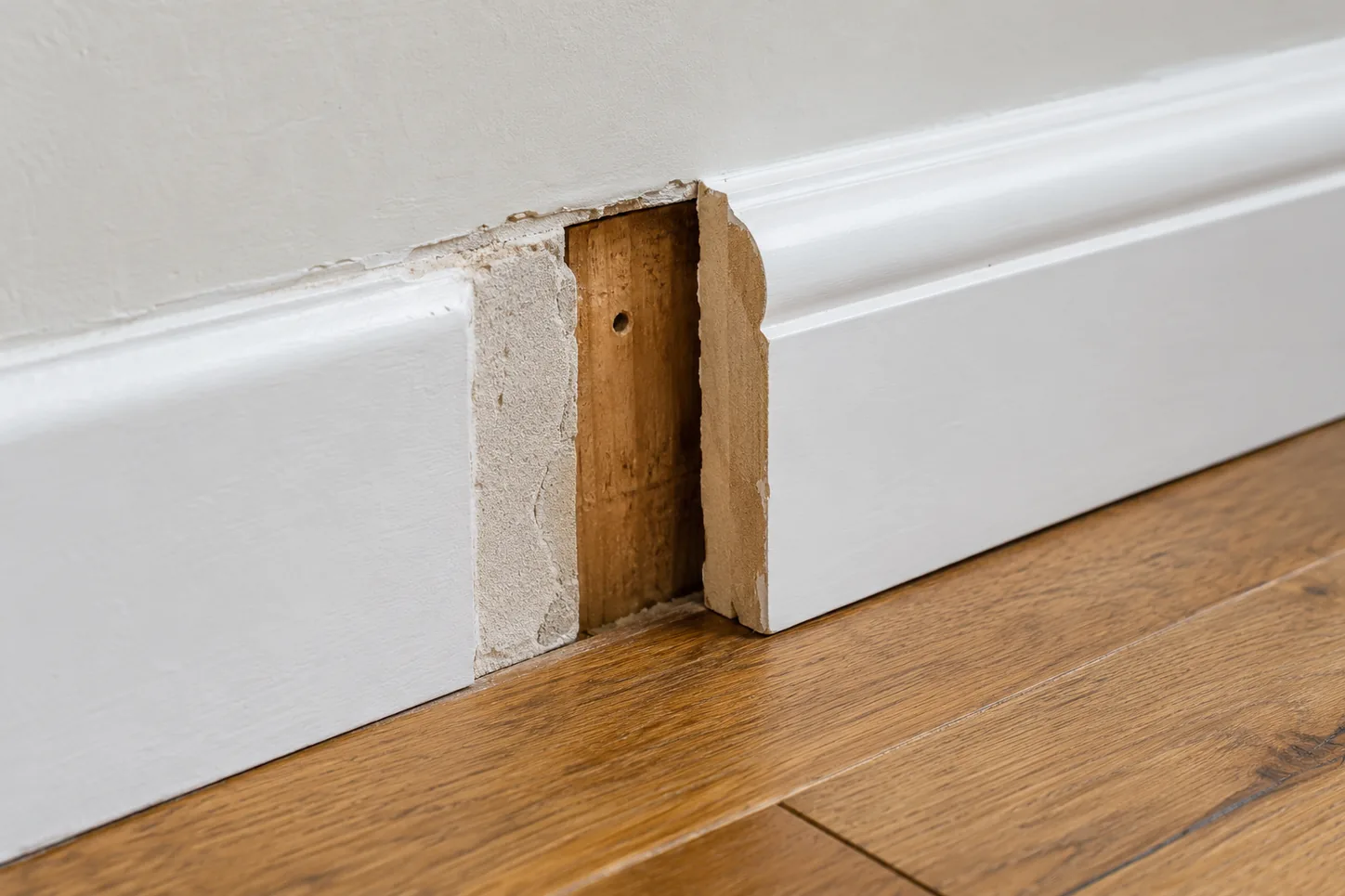
Look at the back of the board where accessible. A split around an old nail hole may mean the wood itself no longer holds a fixing at that point. If paint bridges the top edge, cut the paint line carefully before easing the board away; pulling it abruptly can tear a strip of plaster or wallpaper. On older painted wood, avoid uncontrolled sanding where lead might be present.
Choose the least disruptive sound repair
If the board is intact and the wall behind it has sound timber grounds or studs at the right points, discreet finishing nails or suitable screws may pull it back. Pilot holes near ends reduce the risk of splitting. Set the fixing below the visible face only as far as needed for a small fill. A board held by a tiny head in soft material will simply move again, so confirm what the fastener enters.
On masonry, a suitable plug-and-screw method may be needed, but the board can be damaged by overtightening. The fixing must be chosen for the wall material and placed clear of services. In a plasterboard partition, fixing into a stud or suitable backing is generally more dependable than relying on a fragile edge of plasterboard; a specialist may need to locate the structure and choose a system for the load.
Construction adhesive can supplement a fixing where the surfaces are clean, dry and compatible. It is not a magic substitute for removing loose dust, failed paint or damp. Some adhesives require the board to be held in position while curing. If the skirting is badly bowed, adhesive alone may leave a gap as soon as the temporary pressure is removed. Read the product instructions for surface preparation and cure time.
Do not glue a whole length permanently over a joint that will need access to hidden services. Nor should you use expanding foam to force the board into place; it can push it farther out and create a messy void. Aim for a repair that is firm, neat and proportionate to the actual defect.
Refit and test before decorating
Clear old debris from behind the loose section. A hard lump of dried adhesive can hold the board away even when the new fixing is strong. Offer the board back and check its line at the corners and any joints. If it meets another length, preserve the original profile and avoid one board sitting proud. A helper can hold the long run while fixings are made, rather than pulling one end tight and leaving a wave in the middle.
Work from a stable point towards the loose section, securing into verified sound substrate. Tighten gradually. Stop if the board cracks, the wall plug spins or the plaster begins to crumble. Those are signs the fixing choice or substrate needs reconsideration. Once secured, press along the top edge and check that it no longer flexes away.
Only then finish nail holes and minor surface marks with a suitable wood filler. Allow it to cure, smooth it carefully and prime exposed timber as required by the paint system. A fine bead of paintable decorator’s caulk can close a narrow, stable gap at the wall. Keep it thin; a deep gap may indicate the board has not actually been refitted or the wall surface needs local repair. Paint after the materials have cured.
When replacement is the better answer
A split, warped or rotten board may not sit flat even with good fixings. Removing it and matching a new section can be less damaging than adding fasteners across a failing length. Match the profile, height and thickness, especially in an older room where the skirting may not be a standard modern size. A new section must meet adjoining corners neatly and allow for the flooring detail.
If the wall itself is friable over a long run, it may need plaster repair or new backing before the skirting can be fixed. Similarly, a gap caused by ongoing movement should be diagnosed before it is hidden. The site’s carpentry service is relevant for matching and fitting skirting, while handyman repairs can cover a modest sound-board refixing job.
Explain whether the board is dry, how long a section is loose, what type of wall it is if known, and whether it returns flat under light pressure. A close photo of the gap and a wider photo of the room corner help. The aim is a board held by sound material, with caulk and paint used only to finish a repair that already works.