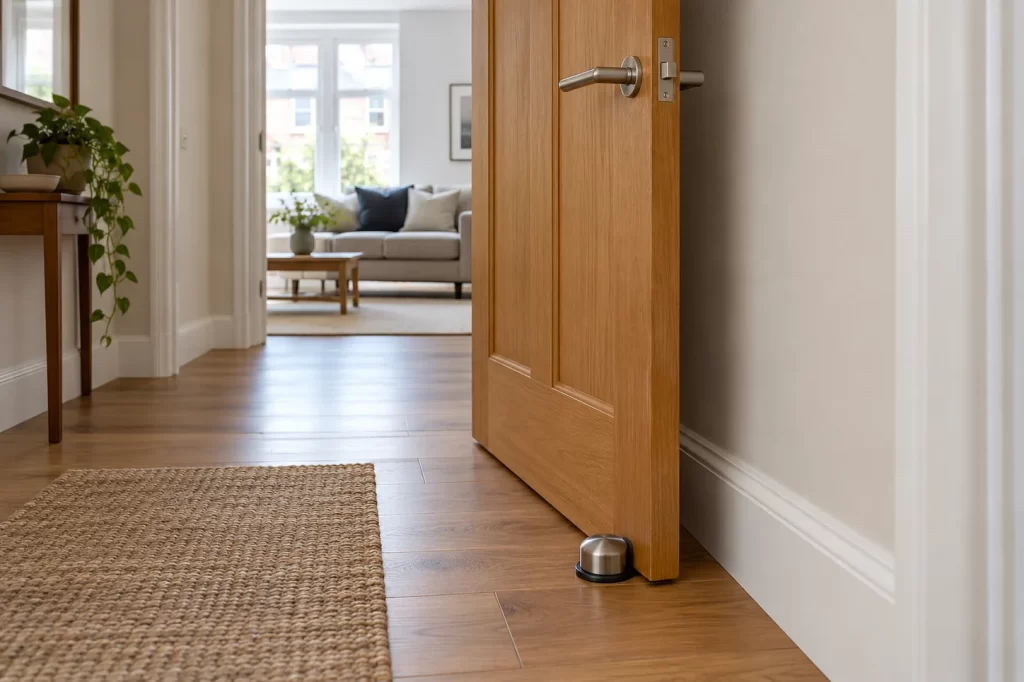
A slamming internal door is often blamed on the door itself, but the force may come from airflow through the home, a poorly placed stop, an unsuitable closer or loose hardware. Start by noticing when it slams. A door that swings hard only when a window is open needs a different remedy from one that accelerates every time it is released. The aim is a door that can be opened and closed normally without striking a wall, pulling at its hinges or trapping fingers.
This guide covers ordinary internal doors. Fire doors, smoke-control doors and doors on an escape route may need to close and latch as part of the building’s safety arrangements. Do not wedge one open, remove its closer or change its seals to make it quieter. Ask the building manager or a competent door specialist to assess it.
Observe one ordinary closing cycle
Stand clear of the swing and release the door gently from a small opening. Watch its speed and where it first makes contact. Is the noise the leaf hitting the frame, the handle striking a wall, or the latch snapping into the keep? These are three distinct problems, even though people describe all of them as a door slam. Repeat only if it can be done without risk to fingers, glass or nearby belongings.
Then try the door with nearby windows and other internal doors in their usual positions. A pressure change can pull a door shut suddenly when a window is opened, an extractor fan runs or air moves along a corridor. If the force appears only in that situation, changing the hinge may do little. You need to control the door’s travel or address the airflow pattern, while retaining any required ventilation.
If the leaf falls towards its closed position even in still air, look at its hanging. A door out of plumb can swing under its own weight. Hinge wear, loose screws or a frame that has moved can change the angle. A door that drags across the floor or has an uneven reveal needs alignment checked before a stop is added; the existing guide to a door rubbing on the floor explains that diagnosis.
Decide whether the door or the handle needs stopping
When a door opens into a wall, the handle often reaches the plaster before the door edge does. A small dent behind the handle is a useful clue. Repeated impacts can loosen the handle, crack plaster and pull the hinge side of the frame. A doorstop should intercept the door at a point that leaves the handle clear of the wall, rather than merely hiding the mark with a rubber cap.
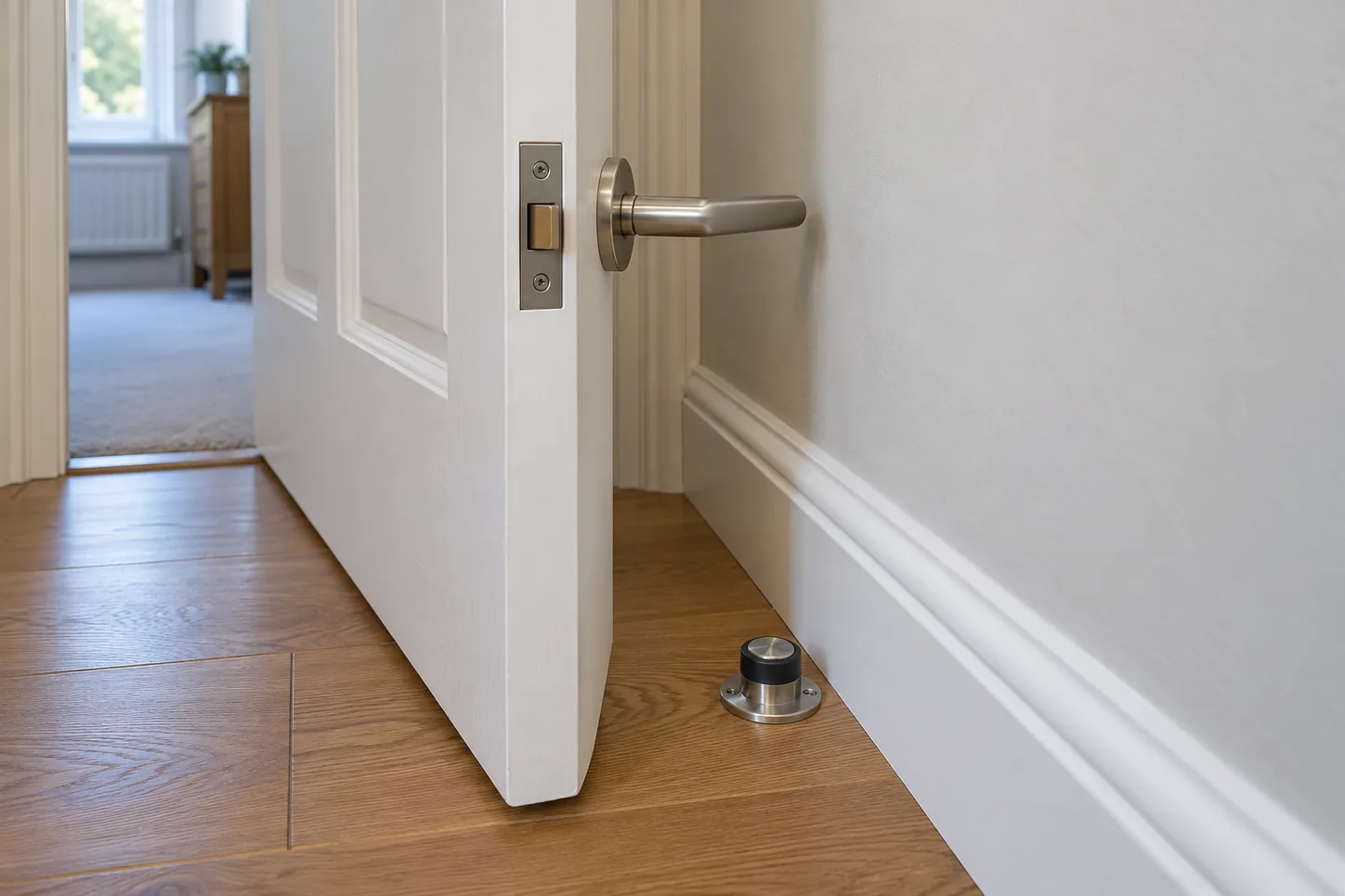
Hold the door at the maximum useful opening angle and check the full clearance. Think about furniture, a radiator, skirting, cleaning access and the width needed to carry items through. Mark the proposed stop position temporarily with tape; swing the door slowly to confirm the leaf will meet the stop before any other part contacts the wall. Do not install a fixing through a floor until you know its construction and what may run beneath it. Underfloor heating or hidden services can change the safe installation method.
A floor-mounted stop can be discreet on a suitable solid floor. A wall-mounted stop may make sense where the wall has an appropriate fixing position and the point of contact is sound. A hinge-pin stop is sometimes useful when neither floor nor wall fixing is desirable, but it places load through hinge hardware and may be unsuitable for a heavy door. Follow the product’s door-weight and installation instructions. A soft pad at the point of contact reduces noise, but it does not excuse a weak fixing.
If airflow is the driver, manage the movement
Pressure-driven slamming can be abrupt: the door remains still until a window or another door changes the flow, then moves quickly. Avoid using a loose wedge as a permanent remedy. Wedges can slip, obstruct a route and become a trip hazard. A purpose-made hold-open device may be suitable for an ordinary internal door where its fixing, user access and door type have been checked.
Consider how the room is used. A bedroom door may need to close for privacy, while a utility-room door may be left open during the day. A device that holds the door open but is difficult to release can be as frustrating as the slam. In households with children, choose a solution that also limits finger trapping at the hinge side. Protective strips or guards are only effective when correctly selected and fitted; they are not a substitute for supervising young children around moving doors.
If the door must remain shut, a suitable closer can slow its closing movement. The correct type depends on the leaf, hinges, frame and purpose. Avoid a generic spring device that adds force without control; it may make the latch impact louder. A closer with adjustable sweep and final latching speed needs to be set so the door closes reliably without striking hard. Never assume the same setting applies to a fire door or a communal-door assembly.
Inspect hinges and fixings before fitting more hardware
With the door open, look at the hinge leaves and screws. The metal should sit flat against door and frame, without a visible gap around screw heads. If the upper hinge is loose, the door may move or twist as it swings. A clicking sound can come from a worn hinge pin or a screw working in an enlarged hole. Tighten only screws that still grip firmly; forcing a larger screw into weak timber without understanding the frame can split it further.
The door’s own travel should feel smooth. If it catches at one point, look for paint build-up, a swollen edge or movement in the frame. Do not plane a door merely because it swings quickly. Planing removes material permanently and can create an uneven gap, especially where a change in humidity caused a temporary tight spot.
Check the handle and latch too. A sharp metallic bang at closure may be the tongue striking a misaligned keep. A door that closes softly when the handle is held down but bangs when the latch operates is giving you a useful clue. In that case, adjust or repair the latch relationship instead of adding a heavy stop to the opening side. The site’s broad article on door repair problems places such faults in the wider repair context.
Select a stop for the actual surface
The best-looking stop is not necessarily the safest one. A thin skirting board may not hold a heavy wall stop securely, especially if it is fixed only into plasterboard. A floating floor may need movement allowance that a through-fixed stop would interfere with. In a bathroom, drilling an unknown tiled floor can risk waterproofing or pipes. Where the construction is uncertain, ask a fitter to identify a suitable method.
Check door weight and likely impact. A light hollow-core bedroom door and a heavy solid-core door impose different loads. A product fixed too close to the hinge may concentrate force; one fixed too far away may snag feet or cleaning tools. Follow the stop maker’s positioning guidance and test with slow movements before normal use. The contact should be broad and cushioned enough to avoid leaving a mark on the door face.
Adhesive bumpers can help with a light contact point but have limits. Dust, paint condition, cleaning products and temperature changes affect adhesion. An adhesive pad stuck over damaged plaster will often peel away with the surface. Repair the substrate first and do not rely on a small pad to stop a heavy door moving at speed.
When to ask for a door repair
Arrange a door repair assessment if the door swings by itself in still air, the hinges move in the timber, the frame has cracks, or the latch bangs despite a gentle closing motion. A technician can check the hanging and hardware before choosing a restraint. For a straightforward stop or minor fitting in an ordinary room, the site’s handyman and odd-jobs service is another relevant route.
Describe the conditions: which direction the door moves, whether a window or extractor is on, what it hits, and whether it has a closer. A short video made from a safe position may show the problem more clearly than a still photo. Do not film a door repeatedly slamming into glass or a person simply to document it.
A good remedy controls the movement at its source and protects the surfaces around it. Observe the airflow and door hang, decide what actually makes the noise, then place any stop or closer for that specific door. That sequence prevents a small nuisance from becoming a damaged handle, loose hinge or cracked frame.