

Clear boundaries for busy mixed-use buildings

Handyman Planning for Peckham Homes and Premises

Peckham combines homes above shops, converted properties, estates and residential streets. Good minor works planning starts by identifying the responsible party, the safe working window and the exact defect before tools arrive.

  • Home and communal responsibilities separated
  • Noise and customer access considered early
  • Existing details repaired where practical
  • Completion recorded for owners or managers
Handyman arriving beside mixed London shopfronts and flats
Peckham property focus
15+ years of experience
London and M25 coverage
One accountable team

PROPERTY DECISIONS

Find the responsible surface before defining the repair and Separate public-facing time from practical working time

01

Find the responsible surface before defining the repair

In a flat above a shop or a purpose-built block, the visible fault may sit across more than one responsibility. An internal stain can relate to the dwelling above, a shared pipe or exterior fabric. A loose entrance fitting may serve one occupier or the entire building. Before booking, state the tenure, identify any managing agent and photograph the wider location. Read the lease or tenancy where a wall, door or service is shared. This is not paperwork for its own sake. It prevents a handyman from altering common property or covering a symptom that another party must investigate. For a business premises, add the person authorised to approve a change and the hours when noisy work is acceptable. Once responsibility is clear, ordinary internal adjustments and fittings can be planned without turning the appointment into a dispute at the door.
02

Separate public-facing time from practical working time

A small premises needs a different sequence from an empty room. Identify customer routes, staff areas, food or stock zones and the point where tools can be stored securely. Dusty drilling should not take place beside uncovered merchandise, and an entrance adjustment cannot leave the door unsecured while the business is open. Agree a window for noise, isolation and testing. In a home above the premises, communicate about vibration and access rather than assuming commercial opening hours settle everything. Prepare replacement products and approvals in advance, since a missing bracket can waste a limited slot. At completion, remove packaging, operate the fitting under normal conditions and tell the responsible person about curing time or use restrictions. A defined handover matters when the person who ordered the work is not the person opening the property next morning.

03

Make a flat maintenance list that distinguishes cause and finish

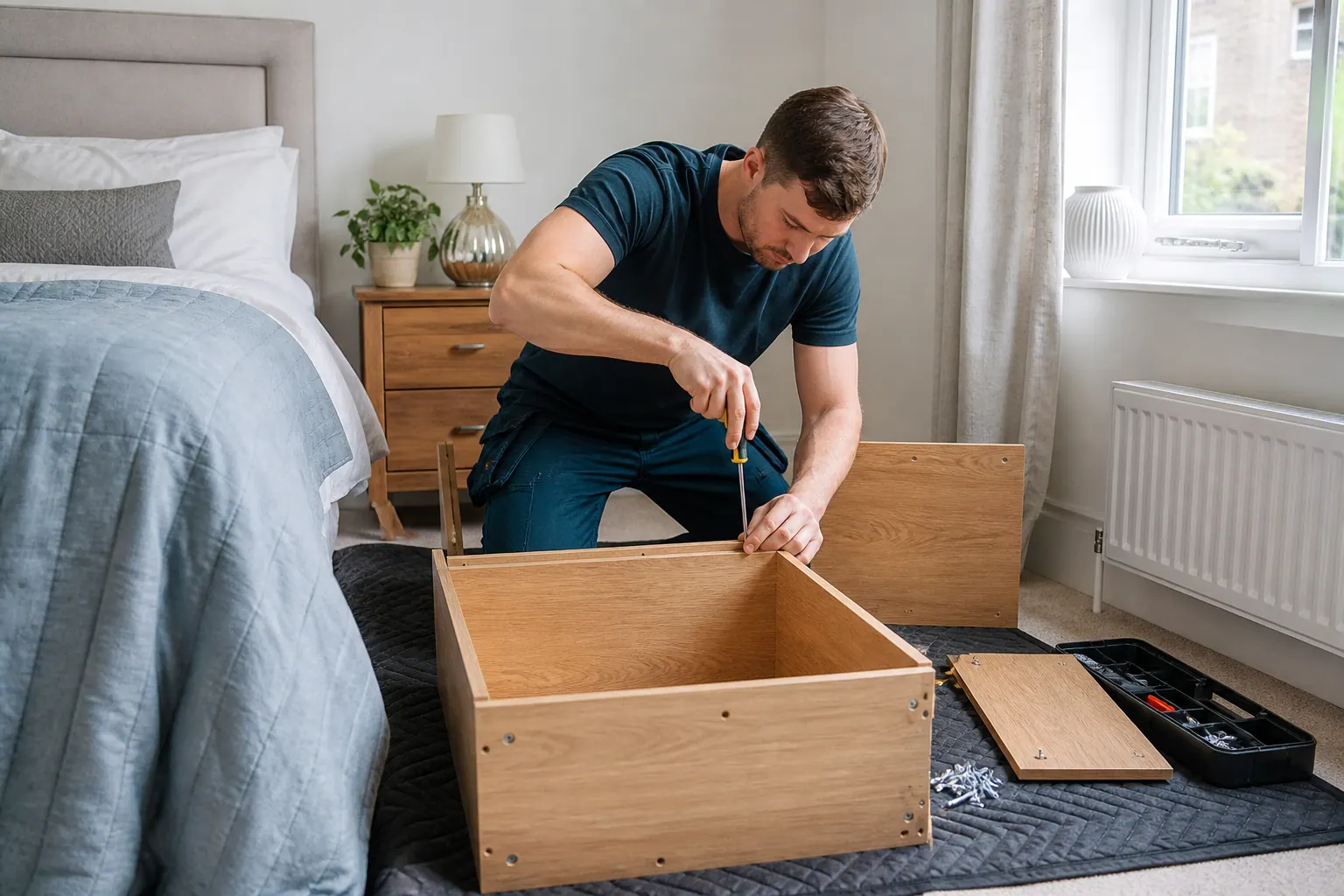
Checkout and move-in lists often mix faults, decoration and improvements. Separate them. A door that rubs needs its hinge, frame and seasonal pattern considered before repainting the edge. A ceiling mark needs its moisture source resolved and the surface dried before stain treatment. A shelf request needs load, wall type and landlord approval. Furniture assembly needs model information and enough floor space. This classification helps the urgent defect lead to the right action and stops a cosmetic line item from hiding an unresolved cause. Add photographs taken in consistent light and retain a copy after completion. Where several occupants report a fault differently, a short video of the movement can be more useful than adjectives. The list becomes a maintenance record instead of a collection of vague complaints.

SCOPE AND ACCESS

Reserve time for the evidence-backed list

The visit length should reflect the number of prepared tasks, access constraints and drying or testing needs, not simply the number of bullet points.

Discuss your property requirementsCall 020 3137 9380
Traditional cabinet hardware being measured for a compatible repair

PECKHAM PROPERTY NOTES

Repair useful details before choosing a generic replacement

Peckham’s town-centre heritage is not confined to individually listed buildings; Southwark’s appraisal also values coherent groups and street frontages. Indoors, the same practical principle applies at a smaller scale. A loose handle, damaged cupboard catch or shop display fitting may need a matched component, not the nearest modern substitute. Photograph the fixing centres, back plate, thickness and surrounding finish. Keep the removed part until the replacement works. An old screw hole should not simply receive a larger screw if the material around it has failed. A repair may involve relocating the fixing into sound material, inserting a suitable repair, or accepting that the item needs specialist joinery. Where appearance matters, agree what “matching” means: dimensions, finish, operation or all three. This makes the choice deliberate rather than accidental.

FINISHING AND HANDOVER

Use specific service routes where the risk changes and Leave a record that works for the next occupier or manager

01

Use specific service routes where the risk changes

Odd jobs suits a defined group of small independent tasks. Door repair is more useful when a leaf, frame, closer or lock alignment is the main issue. Furniture repair should receive close views of the failed joint or component, while assembly requires the product model and complete cartons. A water mark or active leak belongs with leak investigation before decorating is discussed. Electrical symptoms need the electricians route rather than being buried at the bottom of a general snagging list. For shop or office fittings, describe the operating hours and who owns the surface. This service-led approach does not fragment a sensible booking; it reveals where preparation, qualifications or separate timing are needed.

02

Leave a record that works for the next occupier or manager

A useful completion note names the item, room, action and any limitation. Keep photographs where work will later be hidden by furniture. Store product manuals, spare fasteners and paint references with the property rather than with an outgoing occupier. If an item could not be completed, state why: wrong component, insufficient permission, weak background or need for another trade. Avoid calling a temporary stabilisation a permanent repair. In commercial space, make sure the opening manager understands locks, shutters or display fittings that were adjusted. In a rented home, agree who owns newly fitted items and what happens at checkout. This small discipline reduces repeated diagnosis and helps future maintenance begin from evidence instead of memory.

PRICING

Pricing based on the agreed Peckham job scope

The quotation reflects the task, access, expected time and materials. Photographs and measurements help establish what can be priced before the visit and what first needs inspection.

Handyman labourFrom the published rate
MaterialsAgreed for the job
Additional workApproved before it starts

Parking, congestion and unusual access requirements are discussed where they affect the quotation.

NEARBY COVERAGE

Handyman areas near Peckham

PECKHAM HANDYMAN FAQ

Questions about planning handyman work in Peckham

Can work be arranged before a Peckham shop opens?

Often, if access, the authorised contact, noise limits and the exact tasks are agreed in advance.

Who is responsible for a loose fitting in a communal hallway?

The freeholder, landlord or manager should confirm responsibility before work is instructed; a resident should not assume common property can be altered.

Can a stained ceiling simply be repainted?

Only after the moisture source is resolved, the background is dry and the surface condition has been assessed.

Can original-looking handles be matched?

Sometimes. Measurements, fixing centres, spindle details and finish all help locate or assess a compatible component.

Can a handyman complete a landlord checkout list?

A prepared list can be assessed, but plumbing, electrical, structural or communal items may require separate responsibility or specialist work.

Do conservation rules apply across all of Peckham?

No. Boundaries and controls are address-specific. Use Southwark’s planning information before visible exterior or protected-building changes.

PLAN THE VISIT

Make the Peckham brief clear enough to hand over

Send the defect list, ownership details, opening or access window and the person who can approve decisions. We will help separate practical handyman work from communal or specialist issues.

Call 020 3137 9380Get a quote