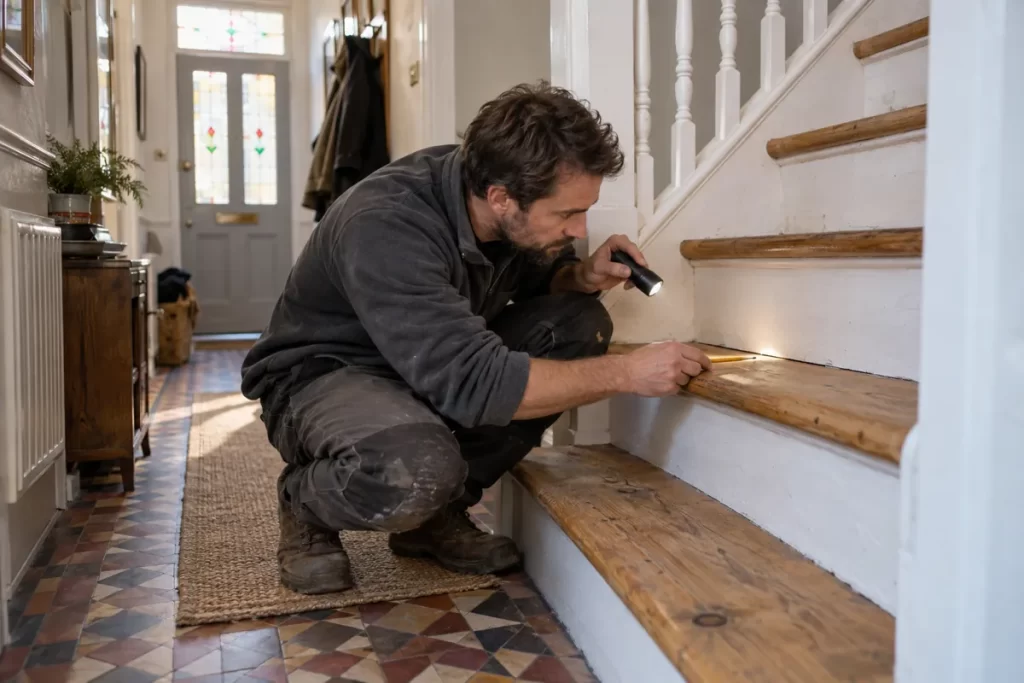
A single creak on the stairs can be surprisingly precise: it happens under your left foot, halfway up, every time. The sound often comes from two pieces of timber moving against each other. Finding which pieces move matters more than buying a tube of adhesive or driving in a screw at random.
Stairs also carry people, furniture and daily wear. If a tread visibly dips, feels loose, or has split timber, treat that as a repair job rather than a noise nuisance. This guide helps you describe the problem, make a few safe observations and understand the options a carpenter may consider.
First, locate the movement
Have someone walk slowly up and down while you listen from a safe position beside the stairs. Note the exact step, the part of the tread underfoot and whether the sound occurs on the way up, down or both. Do not crouch beneath an open staircase while someone is using it.
Watch the joint between the horizontal tread and the vertical riser. A narrow line that opens and closes as the step is loaded points to movement at that joint. A tread that flexes across its middle suggests a different issue from a small squeak at one edge. Check for a crack, a loose nosing (the front lip), or a gap along the wall string. Photographs taken without loading the stair can help a tradesperson assess what you have found.
If you can access the underside without removing fixed panels, look for a loose wedge, separated glue block or an obvious gap. Many London staircases are enclosed, so the underside may not be available. There is no need to dismantle a ceiling or fitted cupboard simply to diagnose a creak.
Why an individual step starts to creak
Older timber stairs are assembled from several parts. Treads sit against risers and strings, often held by wedges, blocks, adhesive and fixings. Timber expands and contracts as indoor humidity changes. Years of footfall can loosen an old fixing or open a fine joint. A squeak is the sound of these surfaces rubbing.
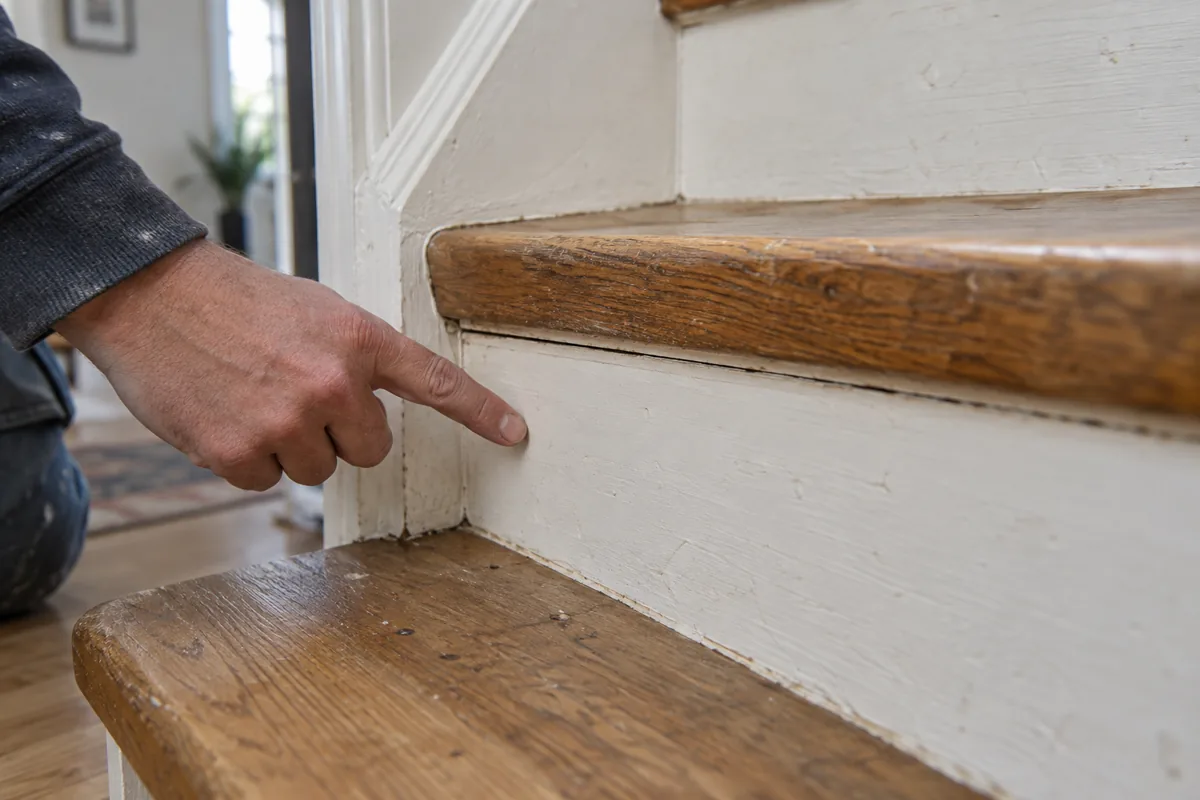
The common patterns are:
- Tread against riser: the joint moves when weight lands near the front or back of the step.
- Nosing or tread board: the front edge shifts or the board flexes. A loose nosing also presents a trip hazard.
- Wedge or glue block underneath: an older support has come loose, sometimes making more than one part of the step move.
- Stair against the wall string: a gap at the side opens as the tread is loaded.
Do not assume every stair noise is a timber joint. A loose carpet gripper, floor covering or trim can click underfoot too. Move a loose runner aside only if it can be done without damaging its fixings; otherwise, ask the fitter or carpenter to check it.
What is safe to check yourself?
You can map where the noise occurs, photograph visible gaps and look for water marks, cracking or loose trim. Keep the staircase clear and use the handrail normally. If a runner has lifted, secure access to the stairs and arrange its refitting. Avoid experiments with a loaded step if you already feel movement.
This is different from a creaky board in a room. Our guide to squeaky floorboards explains a floor problem, but stair treads rely on a tighter assembly and are exposed to a concentrated load at their front edge. Screwing through carpet or filling the top joint with sealant can hide the symptom without restoring support. A misplaced screw may miss sound timber, damage a concealed service or leave a sharp fixing where feet land.
If the staircase is solid and the noise is mild, keep notes for a routine visit rather than pulling it apart. If the step drops, rocks, or has a split across the walking surface, restrict use and ask for a prompt inspection. The same applies if several neighbouring steps begin moving together.
What a proper repair may involve
The repair depends on access and the failed joint. From beneath, a carpenter may be able to refit or replace a wedge, resecure a block, strengthen a tread-to-riser connection and address a failed fixing. With an enclosed staircase, the work may need to be approached carefully from above, sometimes lifting a covering or removing a small piece of trim. The aim is to make the step stable, not merely quiet.
Where timber is cracked, wet or substantially worn, replacing a component may be more reliable than reinforcing a failing piece. A good assessment considers how that tread joins the string and riser, and whether the adjacent steps share the problem. Bob's carpenters can assess timber joinery; for a broader set of small repairs during one visit, see the odd jobs service.
The flooring and tiling team may be relevant if the noise is actually from a landing surface rather than the stair assembly. If a rail is also loose, mention it separately when booking. A handrail repair and a moving tread have different causes and should each be inspected.
Carpet, paint and access can change the plan
Fitted stair carpet makes it hard to see joints or fixings. Tell the carpenter whether you want the covering preserved and whether it was recently fitted. A tread may have creaked before carpeting, but the covering can also introduce a separate squeak at a gripper or edge. Do not make holes in a new runner in the hope of finding the timber below.
Painted stairs create another practical issue: opening a joint or removing a trim piece may disturb the finish. Ask what access is needed and whether making good is included. If you are arranging several property repairs, the handyman visit checklist is useful for gathering photos, access details and a clear list of concerns.
Moisture deserves special attention. A new creak after a leak may indicate swelling or weakening, and the water source needs addressing first. Read the site's guide to signs of a hidden leak if there are stains, a musty smell or unexplained dampness nearby. Drying and timber assessment should precede any cosmetic filling.
Repair or replace the stair?
One localised creak in an otherwise firm staircase usually calls for a targeted inspection and repair. Widespread movement, repeated cracking, decay, or treads that have already been patched several times can change the calculation. Replacement may also make sense during a larger refurbishment, but it is rarely the first answer to one noisy step.
Ask the tradesperson to explain which component moved, how it will be secured and whether the repair requires access to the underside. That gives you a practical way to compare quotes. The cheapest way to silence a stair for a week is not necessarily the repair that will keep it stable.
A creak is useful information: identify its location, look for movement and treat any loose tread as a safety issue. If the staircase needs attention, book a carpentry assessment and share the step number, photos and whether the underside is accessible. That detail helps the visit start with the right tools and a realistic repair plan.