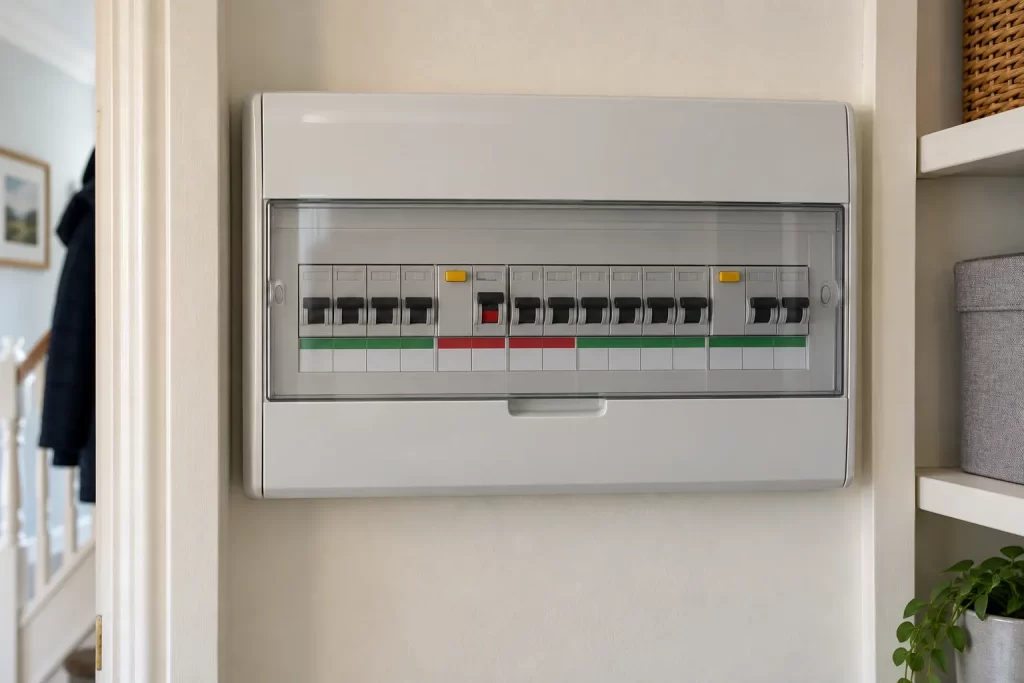
An RCD trips because it detects current flowing along an unintended path. That protective action may be caused by a faulty appliance, moisture, damaged wiring or several small leakages adding together. A homeowner can record what happened and unplug portable appliances, but should never remove the consumer-unit cover, touch wiring or repeatedly force the RCD back on.
Know when not to investigate
Keep away and call a qualified electrician urgently if there is smoke, burning smell, buzzing, visible scorching, water near electrical equipment, a shock or tingling sensation, or a damaged consumer unit. Do not touch wet appliances or stand in water to reach a switch. If there is fire, leave the property and call the emergency services.
A trip that occurs every time you reset, or an RCD that will not latch with circuits switched off, is not a DIY fault-finding exercise. Use emergency electrical support.
RCD, RCBO or circuit breaker?
A traditional RCD may protect several circuit breakers and often has a test button. An RCBO combines residual-current and overcurrent protection for one circuit. A circuit breaker without RCD protection responds to overloads and short circuits. Labelling and layout vary, so read the schedule beside the closed unit rather than guessing.
Do not remove covers to identify a device. If labels are missing or confusing, photograph the closed board and ask a registered electrician to explain and update them.
Record what happened before touching switches
- Time and weather, including recent heavy rain
- Which lights and sockets lost power
- Which appliance had just started or finished
- Whether a shower, boiler, outside light or garden equipment was operating
- Any recent leak, decorating, drilling or appliance move
- The exact switch position and any indicator visible through the closed cover
This evidence helps an electrician reproduce an intermittent fault. Do not erase it by resetting repeatedly.
Prepare for a safe external check
Use dry hands, wear shoes and provide torchlight independent of the affected circuit. Keep children and pets away. Shut down computers and delicate equipment where possible. Do not rely on a phone torch while also operating switches in a cramped cupboard.
Only touch the normal external toggle controls through the consumer unit’s closed front access. Never use tools, press internal parts or defeat a device that will not stay on.
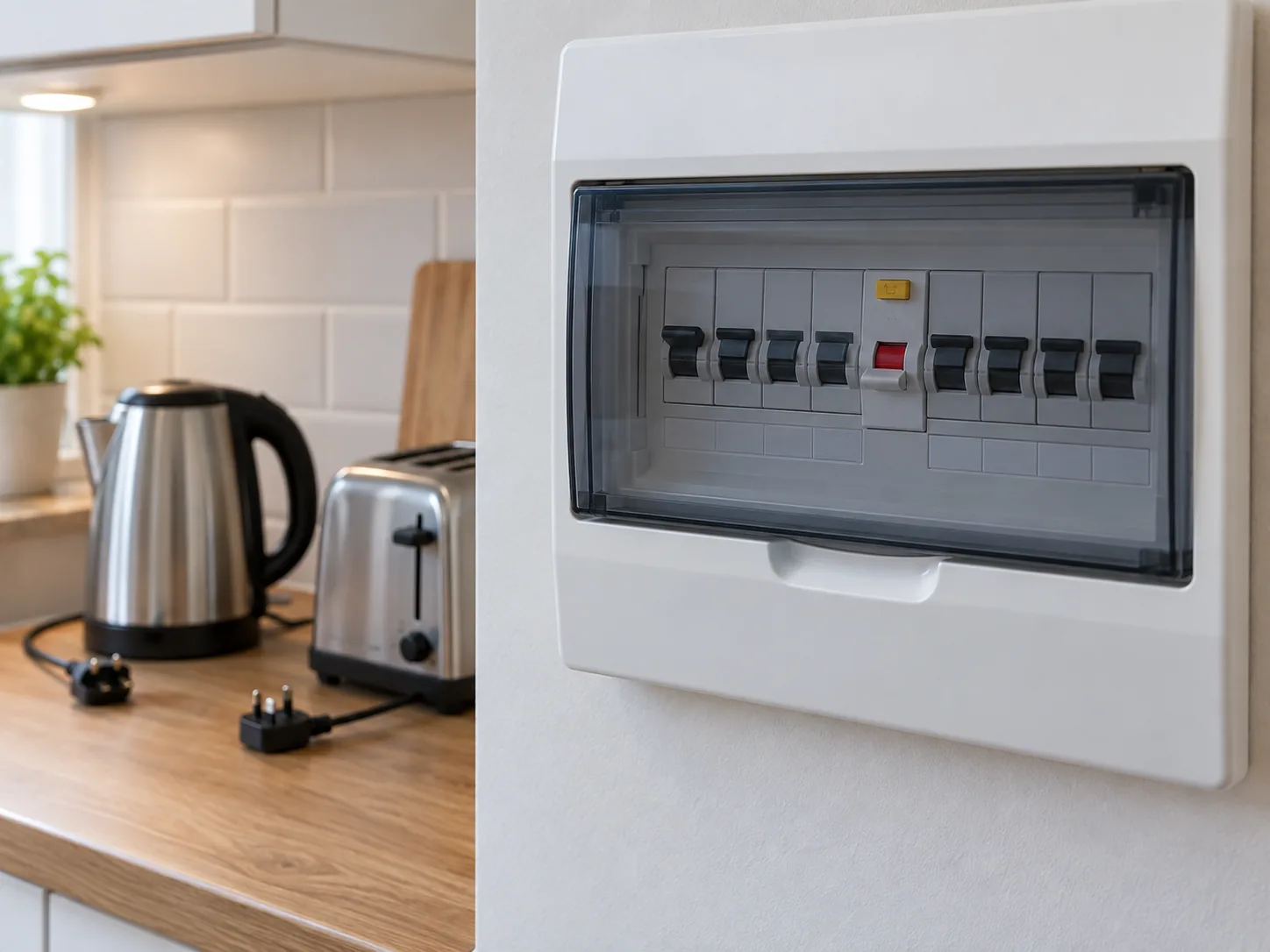
Step 1: unplug portable appliances on the affected circuits
Switch off at the socket and unplug accessible portable equipment such as kettles, toasters, washing machines, lamps and extension leads. Pull the plug, not the flex. Do not move hard-wired appliances, remove fused-spur covers or reach behind wet equipment.
Outdoor extension leads and damp garden tools are common clues after rain. Leave wet items disconnected and do not test them indoors. A plug-in appliance with heat damage, split cable or moisture needs repair or replacement.
Step 2: make one controlled reset attempt
If there are no danger signs and the consumer-unit instructions are clear, move the RCD fully to the off position before returning it to on. Some devices rest in a middle tripped position and will not reset until moved fully off. Do this once.
If it trips immediately, will not latch, makes noise or feels abnormally warm, stop. Do not hold the toggle up. Arrange qualified electrical testing.
Step 3: observe before reconnecting anything
If power remains on, check from a distance for unusual smell, sound or heat. Confirm essential equipment such as freezers has restarted, but do not rush to reconnect everything. Write down that the RCD stayed on with portable loads removed.
Step 4: reconnect portable appliances one at a time
Reconnect only dry, undamaged plug-in appliances, allowing time between each. Operate them normally while remaining nearby. If the RCD trips after one item is connected or when its heater or motor starts, leave that appliance unplugged and label it so nobody retries it.
Do not assume the appliance is conclusively at fault: the circuit may already have background leakage and the extra load merely reveals it. An electrician or appliance technician must test it.
Step 5: stop once a pattern is found
Give the electrician the device labels, affected rooms, timing and suspect appliance. Keep that item disconnected. Do not repeat the trip to demonstrate it, and do not transfer a suspect appliance to another circuit using an extension lead.
Intermittent trips with no obvious appliance
Trips during rain can involve outside lights, sockets, pumps or damaged external cables. Trips during heating cycles may involve immersion heaters, ovens or washing appliances. Night-time events may coincide with timed equipment. These clues are useful, but testing insulation resistance and earth leakage requires suitable instruments and competence.
Moisture after a plumbing leak needs coordinated water-damage assessment and electrical checks before affected circuits return to service.
Do not make these dangerous mistakes
- Removing the consumer-unit cover.
- Holding a protective device in the on position.
- Resetting repeatedly to see whether it eventually stays on.
- Bypassing an RCD or using an unprotected extension route.
- Opening plugs or hard-wired appliances while fault finding.
- Testing wet outdoor equipment inside the home.
- Assuming that one successful reset proves the installation is safe.
What about the test button?
The test button is for periodic functional testing according to the device and installation instructions, not for diagnosing an active unexplained trip. If the supply is already unstable, leave further operation to the electrician. If routine testing fails to trip the device or it will not reset afterwards, arrange prompt inspection.
When the electrician attends
Provide photographs, your written sequence and access to relevant appliances. Mention all recent work, even if it seems unrelated. Do not conceal that a leak occurred or that a device was dropped. Accurate history shortens diagnosis and helps distinguish appliance leakage from a circuit or RCD fault.
Treat the trip as evidence
If the first trip followed work around entertainment equipment, review the separation and access principles in the guide to hiding TV cables safely. Do not use that as a reason to open sockets or fixed wiring.
An RCD is a safety device, not an inconvenience to defeat. External observation and careful unplugging can identify a useful pattern, but the safe limit is clear: one reset, no exposed parts and no repeated experiments. When the trip persists or any danger sign appears, leave the protective device off and use a qualified electrician.