
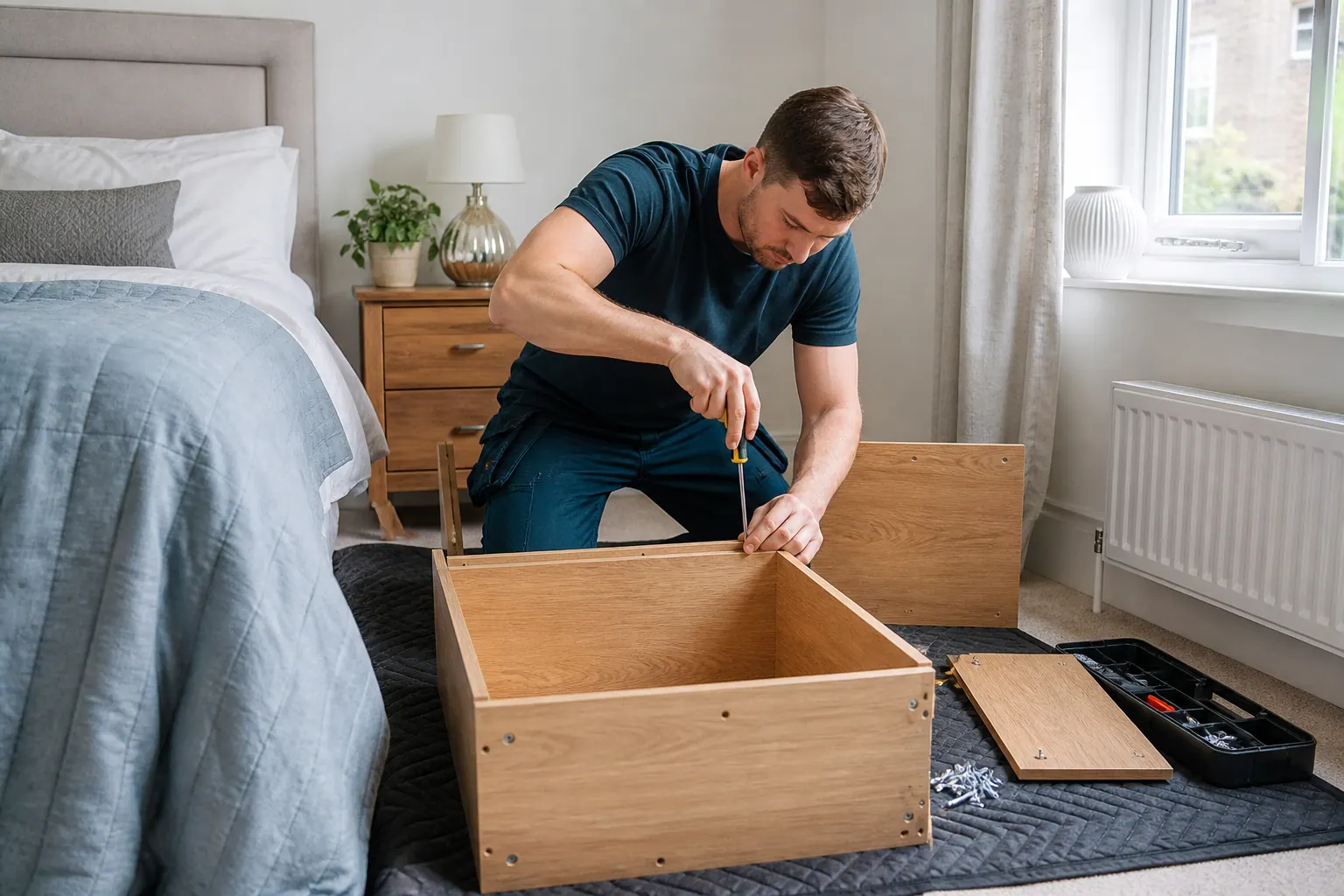
Match the intervention to the material already in place

Compatible Repairs for Holland Park Interiors

Holland Park interiors often combine retained joinery and plasterwork with later services, linings and fitted furniture. Successful maintenance depends on the junction between old and new, not on forcing one standard product onto every surface.

  • Materials identified before filler or adhesive is selected
  • Loads transferred through a suitable fixing interface
  • Reversible options used where future change is likely
  • Samples and product references retained after completion
Handyman comparing material samples beside fitted joinery
Holland Park property focus
15+ years of experience
London and M25 coverage
One accountable team

PROPERTY DECISIONS

The interface carries the load and Choose reversible work when the room may change

01

The interface carries the load

A shelf bracket is only as reliable as the connection between bracket, fixing and supporting wall. Decorative panelling, tile and dry lining may be finishes rather than structural support. Establish the intended load, bracket geometry and build-up behind the visible face. The same principle applies to curtain poles, mirrors, cabinet rails and furniture restraints. A larger screw does not correct a hollow or crumbling fixing point. The position may need to move, the load may need more supports or a different system may be required. Concealed pipes, cables and flues must also be considered. The visual layout should adapt to a safe interface, not dictate drilling into an unsuitable zone.
02

Choose reversible work when the room may change

Art arrangements, rented furniture and audiovisual equipment often move during the life of a property. A fixing strategy can recognise that without becoming temporary or unsafe. Use the minimum appropriate intervention, keep manufacturer components and avoid unnecessary adhesive on finishes that are difficult to repair. Freestanding or rail-based solutions may suit some situations, subject to load and consent. Reversibility does not mean weak work; it means the item can be removed with a defined making-good route. Original or significant fabric deserves particular restraint. Valuable art and complex installations may require specialist handling beyond ordinary picture hanging, even where the wall fixing itself appears simple.

03

Resolve the junction between new and retained work

A replacement bath panel meeting an old tiled floor, new shelving beside existing panelling or a modern handle on an older door all create junctions. Measure gaps, movement and alignment before ordering. Decide whether the goal is a deliberate contrast or a close match; an approximate match can look more accidental than either. Allow access for cleaning and future adjustment. Flexible joints belong only where movement and the product specification justify them. Do not use sealant as a universal gap filler or trim as a way to hide inaccurate dimensions. A neat junction results from understanding both elements and setting realistic tolerances, especially where the retained surface is not straight or level.

SCOPE AND ACCESS

Link approval to a visible proposal

Freeholders and conservation controls may affect protected windows, external details and communal fabric. Approval is clearer when it refers to a drawing, product specification, colour sample or marked photograph rather than a broad request for maintenance. Record exactly what has been authorised and keep that evidence with the property file. Internal routine work does not automatically need planning consent, but leases can still restrict drilling, flooring changes or alterations near common services. Bob’s can work to an agreed practical scope; the owner remains responsible for securing the necessary permissions. If the approved product changes, check again instead of assuming that a similar-looking substitute is covered.

Discuss your property requirementsCall 020 3137 9380
Bracket and fixing components aligned against a layered wall sample

HOLLAND PARK PROPERTY NOTES

Identify the material before choosing the repair product

White walls can conceal lime plaster, gypsum repairs, lining paper, modern board or several generations of paint. Timber may be solid, veneered or a composite core. A filler, adhesive or coating that works on one can fail or cause damage on another. Examine an unobtrusive edge, existing chip or previous repair rather than relying on appearance alone. Product instructions should confirm compatible substrates and preparation. When identification remains uncertain, use a restrained trial or seek specialist advice instead of covering a large area. Keeping a small labelled sample of paint, wallpaper or trim can make later matching more reliable and gives future work a factual starting point.

FINISHING AND HANDOVER

Create a finish register after the room is complete

01

Create a finish register after the room is complete

List the manufacturer, colour reference, sheen and batch where known for coatings and sealants. Photograph spare tile markings, hinge codes and unusual profiles. Note where a sample is stored and which surface it belongs to. This register does not guarantee an invisible future match because materials age and batches vary, but it reduces guesswork. Test repaired doors, mounted items and adjustable fittings before recording completion. General mixed tasks can use odd jobs; joinery, door work, wall painting and picture hanging each have dedicated service information. A future quotation supported by a finish register can focus on the actual repair rather than spending the first visit identifying every retained material again.

PRICING

Pricing based on the agreed Holland Park job scope

The quotation reflects the task, access, expected time and materials. Photographs and measurements help establish what can be priced before the visit and what first needs inspection.

Handyman labourFrom the published rate
MaterialsAgreed for the job
Additional workApproved before it starts

Parking, congestion and unusual access requirements are discussed where they affect the quotation.

NEARBY COVERAGE

Handyman areas near Holland Park

HOLLAND PARK HANDYMAN FAQ

Questions about planning handyman work in Holland Park

Can modern filler be used on every old plaster wall?

No. The plaster type, paint system, depth and moisture condition matter. An incompatible hard repair can fail or damage a softer surrounding material.

Is adhesive mounting safer because it avoids drilling?

Not necessarily. Adhesive can pull away paint or paper and may be unsuitable for the load. The surface, product instructions and future removal all need consideration.

How can a new fitting be matched to older brass hardware?

Compare dimensions, finish and operating parts using a sample or clear photographs. A deliberately compatible choice is better than buying a near-match based only on colour.

Can a television fixing be made reversible?

The bracket can be documented and spare parts retained, but safe support still requires suitable permanent wall fixings. Making good after removal should be planned separately.

Why keep a tile or paint sample after the job?

It records the material and can help source a future repair. Label the room and date because unmarked samples quickly lose their usefulness.

Does approval for one product cover a substitute?

Do not assume so. Different dimensions, materials or appearance may alter the authorised work, especially on visible or protected elements. Confirm any material change.

PLAN THE VISIT

Match the Holland Park repair to the existing fabric

Send a close photograph, a wider view and any product or finish references already held. Bob’s can assess the interface before a new material is introduced.

Call 020 3137 9380Get a quote