
A dry inspection period
Brush away loose debris and allow wet timber or masonry to reveal its true condition. Coating or filler applied to a damp background can hide softness and fail early.
RURAL-EDGE REPAIR PLANNING · BULLS CROSS
Bulls Cross forms one of the small settlements identified within Enfield’s Forty Hill Conservation Area. Gates, outbuildings and older house details need a brief that distinguishes routine adjustment from decay, landscape work or protected alteration.
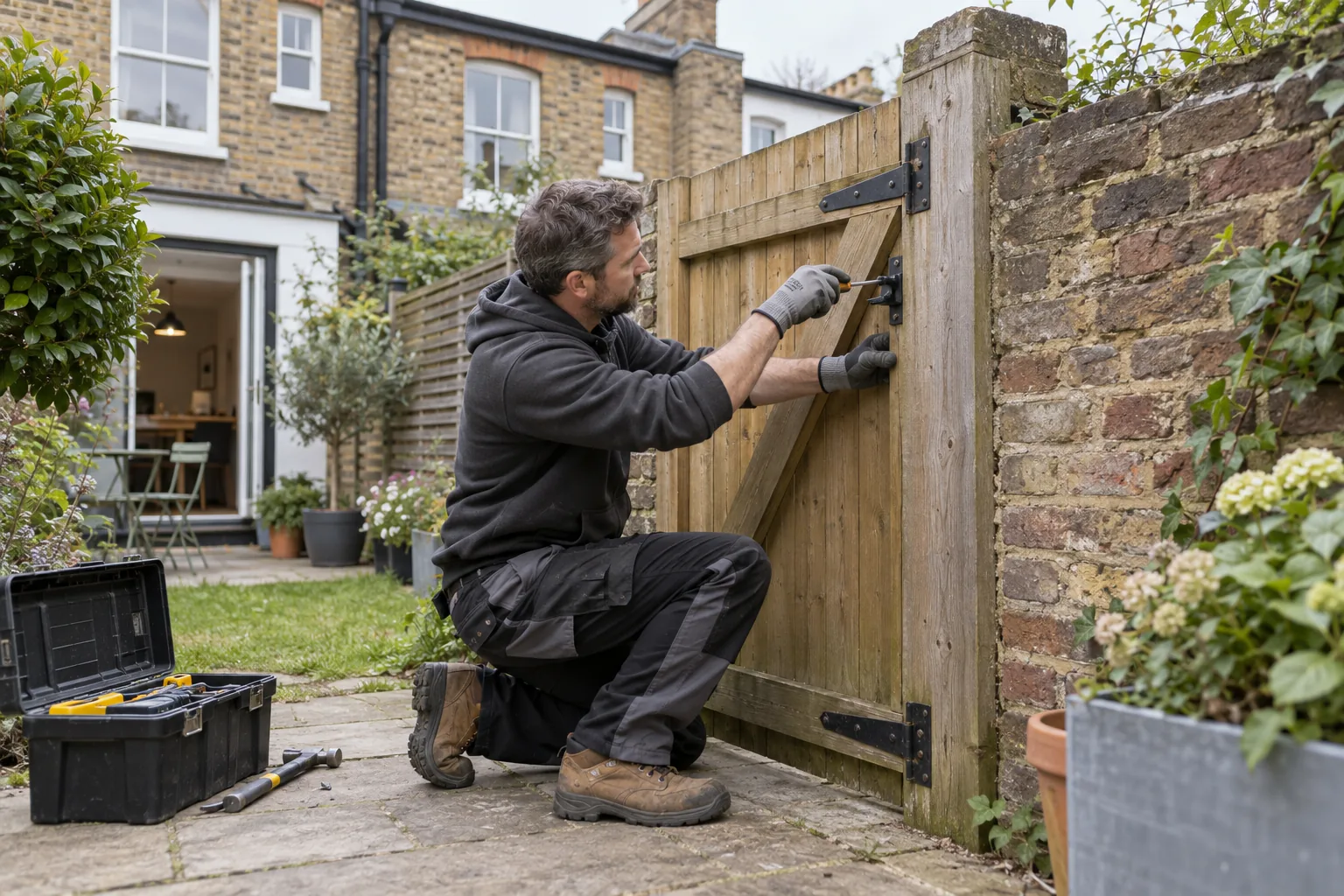

A GATE IS PART OF A MOVING SYSTEM
A gate that drags may have loose hinge screws, a moving post, swollen timber or changed ground clearance. Photograph it closed, half open and fully open. Include the hinge side at ground level and the latch engaging with its keep. Tightening one component without finding the movement can transfer the strain elsewhere.
Soft timber, split rails or a leaning masonry pier changes the scope. Agree whether the aim is a limited hardware adjustment, joinery repair or replacement assessment before taking the entrance out of service.
SETTLEMENT, LANDSCAPE AND PROPERTY EDGE
Enfield’s Forty Hill appraisal identifies Bulls Cross as one of three small settlements along the A105 within a conservation area containing major historic estates and designed landscapes. It also records a wider archaeological priority area. These facts do not prevent ordinary maintenance, but they make assumptions about excavation, mature trees, boundaries and visible exterior changes unwise.
For a handyman visit, define the privately controlled element. A loose internal cupboard and an ordinary garden-gate latch are very different from a boundary wall, tree attachment, buried post or alteration affecting a protected frontage. The owner should check permissions and ownership while Bob’s assesses the practical minor-work portion.
DESIGN AN OUTDOOR WORK WINDOW
Outdoor maintenance should not begin merely because one dry hour appears. Preparation, coating cure, overnight security and the next forecast all shape what can be completed responsibly.
Brush away loose debris and allow wet timber or masonry to reveal its true condition. Coating or filler applied to a damp background can hide softness and fail early.
Before removing hinges or a latch, decide how the entrance will close if a damaged part cannot be reused. A property edge must not depend on an uncertain delivery.
Use labelled trays for screws, packers and hardware. Outdoor components dropped into soil or gravel are easily lost, while mixed screws can return to the wrong hole.
Place tools and removed leaves on protection rather than lawns or beds. Work beside trees, roots and boundary vegetation stays within the agreed footprint.
State when a coating, filler or adjusted fitting can tolerate rain and normal use. The household should not have to infer this from whether the tools have gone.
USE A WEATHER HOLD POINT
Allow for preparation and product cure, not only the visible fitting time.
Choose a safe closed condition if a replacement part or specialist is needed.
Keep hinges, packers and fixings in their original positions for comparison.
Remove protection and state the first time for normal use or rain exposure.
PRICE THE DEFINED ADJUSTMENT
The calculator applies Bob’s published weekday labour rates to a selected task and duration. Timber, hardware, parking, specialist joinery, post replacement, landscape work and permission-dependent alterations are excluded until reviewed.
CLOSE THE WEATHER WINDOW
At completion, note the final dry condition and any minimum time before rain, cleaning or repeated operation. Return labelled old parts rather than abandoning them beside an outbuilding. If the scope stopped because timber was soft, a post moved or permission remained uncertain, secure the element and name the next route. The record should distinguish a planned pause from a completed weatherproof repair.
The owner knows when the treated area may meet rain, frost or normal handling.
The entrance closes in the condition that will remain after the operative leaves.
Outdoor work areas and planted edges are cleared of screws, offcuts and packaging.
NEARBY COVERAGE
Careful property maintenance around the adjoining conservation area.
Prepared household repairs further south.
Rural-edge property planning to the west.
BULLS CROSS OUTDOOR-WORK QUESTIONS
It depends on inspection, preparation and the stated cure conditions of each product. The plan should cover the period after tools leave, not only the appointment itself.
A secure temporary arrangement must be agreed before removal. Label the parts and schedule the compatible replacement or joinery route without leaving the entrance uncertain.
Not automatically. The owner should verify the address and obtain advice for protected or visible alterations; ordinary maintenance still needs a compatible method.
Allow for the agreed inspection, adjustment and operation test. Sourcing hardware, waiting for dry conditions and work to a moving post or decayed timber are assessed outside that simple duration.
Use labelled covered trays on a stable protected surface. Keep sharp pieces out of paths, lawns, gravel and planted beds.
Record the dry condition, product used, first safe handling time, expected rain exposure and any part deliberately left for a specialist.
SHOW THE WHOLE PROPERTY EDGE
Provide wide photographs, the complete opening arc, ground contact, hinge fixings and latch measurements. State ownership, access needs and known heritage or tree controls. Bob’s can then assess an ordinary repair without allowing a small hardware request to conceal a post, drainage or joinery problem.