
Is your cabinetry suitable for painting?
Solid timber, painted MDF and some manufactured finishes may be suitable, but their preparation differs.
A considered new finish for existing cabinetry
Cabinet painting can change the character of a room without replacing sound units. Durable results depend on cleaning, preparation, suitable coatings and enough time for each stage to cure.

WHAT WE CAN HELP WITH
The scope is reviewed around the property, existing condition and the result you need.
Solid timber, painted MDF and some manufactured finishes may be suitable, but their preparation differs.
Doors and drawer fronts may be labelled and removed where appropriate.
Samples should be viewed in the actual room because daylight, artificial lighting and surrounding colours change their appearance.
CABINET PAINTING LONDON
Solid timber, painted MDF and some manufactured finishes may be suitable, but their preparation differs. Peeling laminate, water-swollen board and unstable old coatings can limit the result. We inspect representative areas, discuss existing damage and consider a test patch where adhesion is uncertain. Painting improves appearance; it does not repair structural carcasses, failed hinges or moisture sources unless those items are separately included.
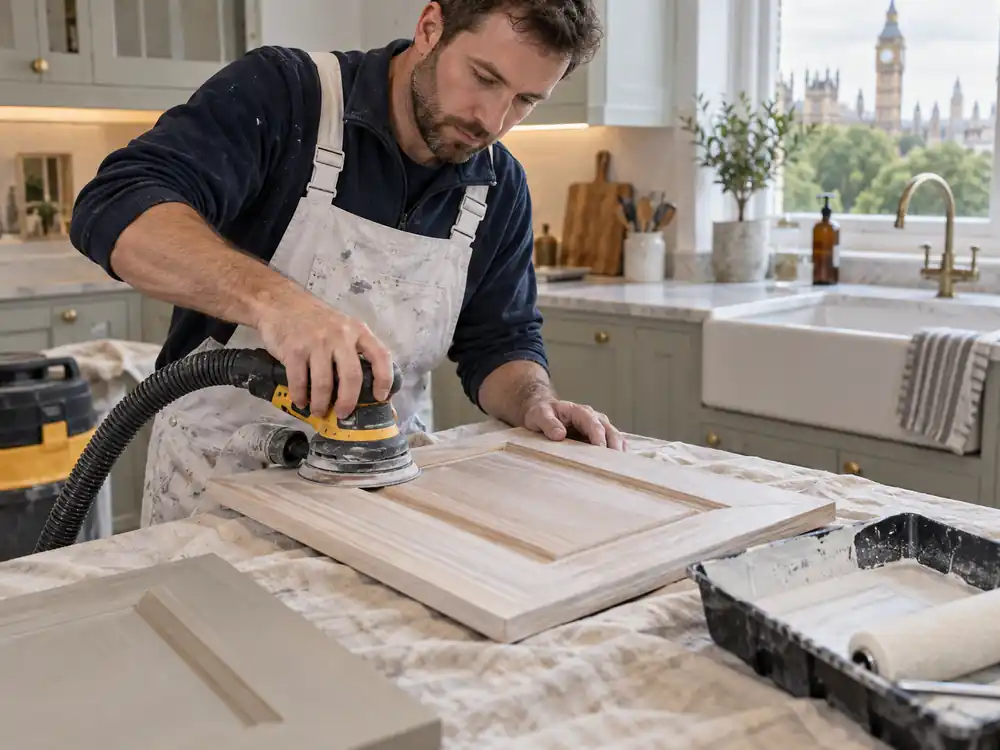
Doors and drawer fronts may be labelled and removed where appropriate. Grease, polish and household residue must be cleaned before sanding or adhesion preparation. Holes, chips and open joints are assessed and filled where suitable. Adjacent worktops, floors, appliances and walls are protected. Rushing this work can leave visible edges, contamination or poor adhesion, so preparation is treated as part of the finish rather than an invisible extra.
Samples should be viewed in the actual room because daylight, artificial lighting and surrounding colours change their appearance. Lower-sheen finishes can feel calm but still need to withstand cleaning; higher sheen highlights surface irregularities more readily. The coating system must be compatible with the substrate and existing finish. We can discuss practical options, while final colour choice and manufacturer performance remain tied to the selected product.
CAREFUL PROPERTY WORK
Primer, undercoat and finish coats are applied according to the agreed system, with drying time and light preparation between stages where specified. Brushed, rolled or sprayed methods create different logistics and finishes. A coating may feel dry before it is fully cured, so freshly finished doors need gentle use. Handles and hinges are refitted carefully, and adjustment is made where it falls within the agreed scope.
Kitchen work affects everyday routines. Agree which areas can be used, how doors will be stored and when ventilation is needed. Food, utensils and small appliances should be cleared from exposed areas. In flats, communal access and acceptable working hours may influence the programme. A staged approach can sometimes reduce disruption, but it may extend the overall duration. The method should suit both the finish and the property.
Use gentle cleaning products and avoid abrasive pads, steam concentrated on edges and standing water around sinks. Allow the full stated curing period before heavy cleaning. Chips from impact and movement are maintenance issues rather than evidence that every coating has failed. Keep leftover labelled paint for touch-ups. Where recurring moisture or door misalignment is present, correct the cause so the new finish is not repeatedly damaged.
A CLEAR PROCESS
Send the London postcode, photographs, measurements and the result you want.
The requirements, access, materials and appropriate trade are reviewed before work begins.
The planned work is carried out carefully, with any material change explained clearly.
CABINET PAINTING FAQ
Useful answers for planning the work.
Some can, subject to condition, cleaning and an appropriate adhesion system. A test area may be advisable.
Often, because it improves edge access and labelling, but the method depends on the cabinetry and site.
Usually where the substrate is sound, though the repair may remain faintly visible under certain light.
Light use may be possible once dry, but full hardness takes longer. Follow the selected coating’s cure guidance.
No. Moisture-damaged board may need replacement and the water source should be resolved first.
YOUR NEXT STEP
Send photographs, material details, cabinet count and colour ideas for an initial scope.