
Appliances we can help install
We help with common household appliances including washing machines, tumble dryers, dishwashers, fridges, freezers and selected integrated units.
Appliance fitting for London homes and rentals
A new appliance should fit the space, connect correctly and be ready to use without damage to nearby cabinetry or flooring. We coordinate practical appliance installation for homeowners, landlords and property managers across London.
WHAT WE CAN HELP WITH
The scope is reviewed around the property, existing condition and the result you need.
We help with common household appliances including washing machines, tumble dryers, dishwashers, fridges, freezers and selected integrated units.
Check that the appliance has been delivered, unpacked where practical and is free from obvious transit damage.
The fitter reviews the appliance, location and existing connections before work begins.
APPLIANCE INSTALLATION LONDON
We help with common household appliances including washing machines, tumble dryers, dishwashers, fridges, freezers and selected integrated units. The exact work depends on the model, the available space and the services already present. Share the product details and photographs before booking so access, dimensions and connection requirements can be considered. If the installation involves new fixed wiring, gas work, major plumbing alteration or structural cabinet changes, that part must be assessed by an appropriately qualified trade rather than treated as a simple fitting job.
Check that the appliance has been delivered, unpacked where practical and is free from obvious transit damage. Measure doorways, stairs, lifts and the final opening, allowing for hoses, plugs and ventilation. The water supply, waste point and socket should be accessible and suitable for the manufacturer’s instructions. Integrated appliances also need compatible doors, hinges and fixing kits. These details prevent wasted visits and help distinguish a straightforward replacement from a more involved installation requiring carpentry, plumbing or electrical work.
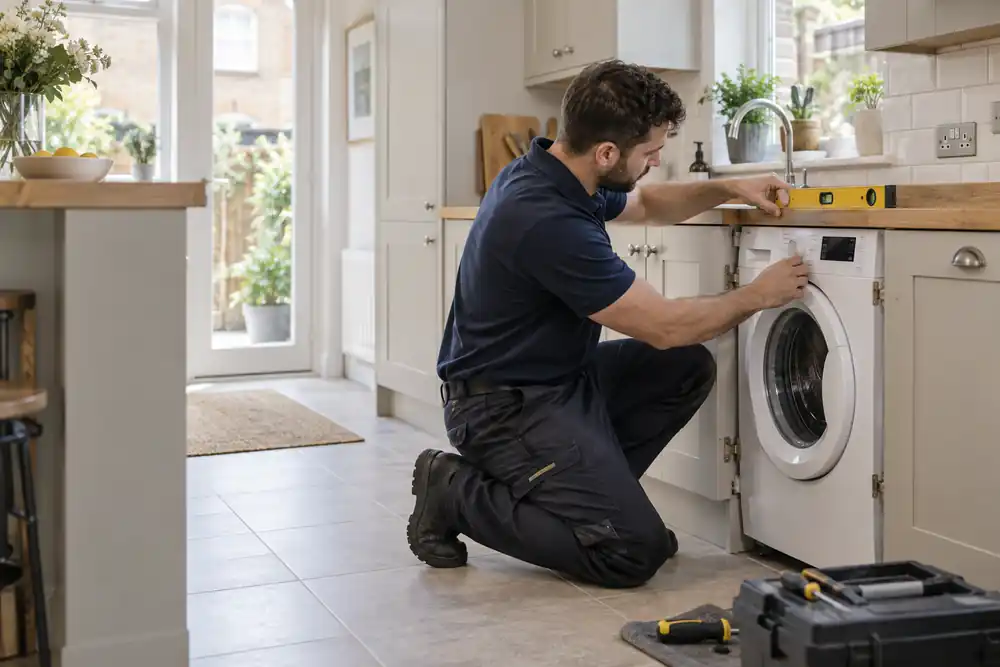
The fitter reviews the appliance, location and existing connections before work begins. The unit is moved into position with reasonable care, levelled and connected only where the existing points are suitable. Hoses and cables are routed to avoid crushing or sharp bends, and accessible fittings are checked for obvious leakage. Doors and plinths are aligned where they form part of the agreed installation. Basic operating checks can then confirm that the appliance powers on and begins its intended cycle, although full commissioning remains subject to the manufacturer’s guidance.
CAREFUL PROPERTY WORK
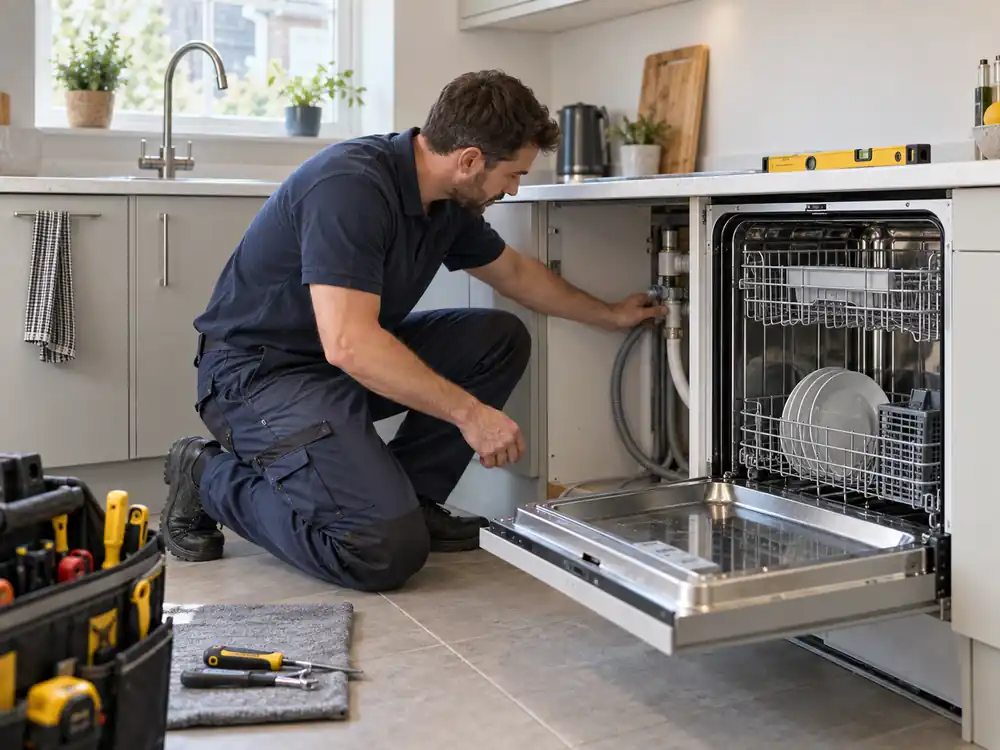
A like-for-like replacement is usually simpler than changing appliance type or size. Integrated models may require adjustment to cabinet doors, hinge positions, plinths and ventilation gaps. Even products sold under the same nominal width can vary in depth and fixing arrangement. We therefore avoid promising a perfect fit until the opening and appliance specifications have been checked. Where modest joinery is needed it can be planned; where the cabinetry needs extensive reconstruction, a separate carpentry scope provides a clearer and safer route.
Parking restrictions, narrow communal stairs and timed building access can affect an installation as much as the fitting itself. Tell us about concierge rules, loading bays, lift dimensions and any floor protection requirements. Remove stored items from nearby cupboards and keep the route clear. If an old appliance is still connected, confirm whether disconnection or disposal is required; removal is not assumed. Tenants should obtain any necessary landlord approval, particularly for integrated units or changes to services.
We do not describe general fitting as gas, electrical or specialist plumbing work. A gas appliance must be handled by a suitably registered engineer. New circuits, unsafe sockets or fixed-wiring changes need an appropriately qualified electrician. Damaged valves, inaccessible pipework or alterations to wastes may require a plumber. Identifying those limits early protects the property and gives you a realistic plan rather than forcing unsuitable work into one appointment.
A CLEAR PROCESS
Send the London postcode, photographs, measurements and the result you want.
The requirements, access, materials and appropriate trade are reviewed before work begins.
The planned work is carried out carefully, with any material change explained clearly.
APPLIANCE INSTALLATION FAQ
Useful answers for planning the work.
Yes, where the cabinet opening, fixing kit and existing connections are suitable. Send the model and clear photographs so door alignment and access can be assessed.
It can be included when agreed and when the existing connections are safe and accessible. Disposal or collection must be confirmed separately.
Minor agreed adjustments may be possible. Substantial resizing or rebuilding should be scoped as carpentry before installation.
Gas connections require a suitably registered gas engineer and are not treated as general handyman fitting.
Share the make and model, opening measurements, connection photographs, access details and whether the old appliance remains in place.
YOUR NEXT STEP
Send the appliance details, photographs and London postcode for a practical review of the fitting required.